MCQ
Glucose and mannose are
  • A
    Anomers
  • Epimers
  • C
    Ketohexoses
  • D
    Disacchrides

Answer

Correct option: B.
Epimers
b
Glucose and manose are isomers, differ in configuration at $C _2$. Isomers which are differ at $C _2$ position are known as epimers.

Need a full question paper?

Generate a complete, print-ready paper with questions like this in minutes — across 16+ boards, with answer keys.

Start Generating Free

Similar questions

$\begin{matrix}
   O\,\,\,\,\,\,\,\,\,\,\,\,\,\,\,\,\,\,\,\,\,\,\,\,\,\,\,\,\,\,\,\,\,\,\,\,\,\,\,\,\,\,\,\,\,\,\,\,\,\,\,\,\,\,\,\,\,\,\,\,\,\,\,\,\,\,\,\,\,\,\,\,\,\,\,\,\,\,\,\,\,\,\,\,O\,\,\,\,\,\,\,\,\,\,\,\,\,\,\,\,\,\,\,\,\,\,\,\,\,  \\
   ||\,\,\,\,\,\,\,\,\,\,\,\,\,\,\,\,\,\,\,\,\,\,\,\,\,\,\,\,\,\,\,\,\,\,\,\,\,\,\,\,\,\,\,\,\,\,\,\,\,\,\,\,\,\,\,\,\,\,\,\,\,\,\,\,\,\,\,\,\,\,\,\,\,\,\,\,\,\,\,\,\,\,\,\,\,\,||\,\,\,\,\,\,\,\,\,\,\,\,\,\,\,\,\,\,\,\,\,\,\,\,\,  \\
   C{{H}_{3}}-C-C{{H}_{2}}-C{{H}_{2}}-C{{H}_{2}}-C{{H}_{2}}-C-H\xrightarrow{H{{O}^{-}}/\Delta }\underset{(73\%)}{\mathop{(A)}}\,;  \\
\end{matrix}$ Product $(A)$ is
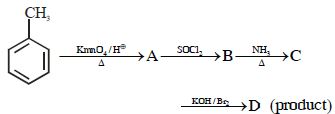
Suppose the following reaction The final product $D$ will be
Molarity of liquid $\text{HCl}$ will be, if density of solution is $1.17 gm/cc.$
If $E.A.N.$ of central metal cation $M^{2+}$ in a non-chelating complex is $36$  and  atomic no. of metal $M$ is $26$, then the number of monodentate ligand is in  this complex are
When chlorine reacts with cold and dilute solution of sodium hydroxide , the products obtained are
Which of the following compound has the smallest bond angle $(X -A -X)$ in each series respectively ?
  $(A)$   $OSF_2$     $OSCl_2$    $OSBr_2$
  $(B)$   $SbCl_3$     $SbBr_3$     $SbI_3$
  $(C)$   $PI_3$     $AsI_3$    $SbI_3$
Extra pure $N_2$ can be obtained by heating :-
Which of the following aquated metal ions has the highest paramagnetism?
Which one of the following is not a correct match?
At higher altitude, boiling point of water is $95\,^oC$. The amount of $NaCl$ added to $1\, kg$ of water $(K_b = 0.52\, K\, mol^{-1}\,kg)$ in order to raise the boiling point of solution to $100\,^oC$ (assuming $90\%$ ionisation of $NaCl$) .......... $g$