MCQ
Glucose reacts with methyl alcohol to give
  • A
    $\alpha - $ methyl glucoside
  • B
    $\beta - $ methyl glucoside
  • Both $(a)$ and $(b)$
  • D
    None of these

Answer

Correct option: C.
Both $(a)$ and $(b)$
c
(c) Alpha methyl glucoside and beta methyl glucoside.

Need a full question paper?

Generate a complete, print-ready paper with questions like this in minutes — across 16+ boards, with answer keys.

Start Generating Free

Similar questions

On adding few drops of dilute $\text{HCl}$ or $\text{FeCl}_3$ to freshly precipitated ferric hydroxide, a red coloured colloidal solution is obtained. This phenomenon is known as:
$3- $ pentanol is a
$\begin{array}{*{20}{c}}
  O \\ 
  {||} \\ 
  {H - C - Cl} 
\end{array}$ is called
What is the potential of a half-cell consisting of zinc electrode in $ 0.01\,m$  $ZnS{O_4}$ solution at ${258\,^o}C$ .............. $\mathrm{V}$ $({E^o} = 0.763\,V)$
When a mixture of ethanol and methanol is heated in the presence of concentrated ${H_2}S{O_4}$ the resulting organic product or products is/are
Match the column $I$ with column $II$ to identify the products of oxidation of alkanes and mark the appropriate choice
  Column $I$   Column $II$
$(A)$ ${\left( {C{H_3}} \right)_3}CH + 2{O_2}\xrightarrow[{\left[ O \right]}]{{KMn{O_4}}}$ $(i)$ $CH_3COOH+H_2O$
$(B)$ $2C{H_4} + {O_2}\xrightarrow[{100\,atm}]{{Cu/523\,\,K}}$ $(ii)$ $(CH_3)_3COH$
$(C)$ $C{H_4} + {O_2}\xrightarrow[\Delta ]{{M{o_2}{O_3}}}$ $(iii)$ $2CH_3OH$
$(D)$ $C{H_3} - C{H_3} + \frac{3}{2}{O_2}\xrightarrow{{{{\left( {C{H_3}COO} \right)}_2}Mn}}$ $(iv)$ $HCHO + H_2O$
The concentration in gms per litre of a solution of cane sugar $(M = 342)$ which is isotonic with a solution containing $6\,gms$ of urea $(M = 60)$ per litre is
In the given table, identify the incorrect option. The digit in box indicate the moles  of that substance

Reactant

$HIO_4$

consumed

$HCO_2H$

formed

$HCHO$

formed

$1.22\, \mathrm{~g}$ of an organic acid is separately dissolved in $100 \,\mathrm{~g}$ of benzene $\left(\mathrm{K}_{\mathrm{b}}=2.6\, \mathrm{~K}\, \mathrm{~kg} \,\mathrm{~mol}^{-1}\right)$ and $100\, \mathrm{~g}$ of acetone $\left(\mathrm{K}_{b}=1.7\, \mathrm{~K} \,\mathrm{~kg} \,\mathrm{~mol}^{-1}\right) .$ The acid is known to dimerize in benzene but remain as a monomer in acetone. The boiling point of the solution in acetone increases by $0.17^{\circ} \mathrm{C}$.

The increase in boiling point of solution in benzene in ${ }^{\circ} \mathrm{C}$ is $\mathrm{x} \times 10^{-2}$. The value of $\mathrm{x}$ is ..... .(Nearest integer)

$[$ Atomic mass : $\mathrm{C}=12.0, \mathrm{H}=1.0, \mathrm{O}=16.0]$
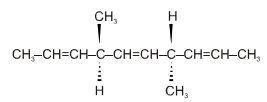
The number of optically active products obtained from the complete ozonolysis of the given compound is: