MCQ
Glycerine has
  • A
    One primary and two secondary $ - OH$ groups
  • One secondary and two primary $ - OH$ groups
  • C
    Three primary $ - OH$ groups
  • D
    Three secondary $ - OH$ groups

Answer

Correct option: B.
One secondary and two primary $ - OH$ groups
b
(b) $\begin{array}{*{20}{c}}
  {\begin{array}{*{20}{c}}
  {C{H_2} - OH} \\ 
  {|\,\,\,\,\,\,\,\,\,\,\,\,\,\,\,\,\,\,\,\,\,\,\,} 
\end{array}} \\ 
  {CH - OH\,\,} \\ 
   {|\,\,\,\,\,\,\,\,\,\,\,\,\,\,\,\,\,\,\,\,\,\,\,}  \\ 
  {C{H_2} - OH} 
\end{array}$
one secondary and two primary alcoholic groups.

Need a full question paper?

Generate a complete, print-ready paper with questions like this in minutes — across 16+ boards, with answer keys.

Start Generating Free

Similar questions

Zinc does not show variable valency like $d-$ block elements because
Reagent which can convert an alkyl amine into alkyl chloride.
Consider a reaction $\mathrm{aG}+\mathrm{bH} \rightarrow$ Products. When concentration of both the reactants $\mathrm{G}$ and $\mathrm{H}$ is doubled, the rate increases by eight times. However, when concentration of $\mathrm{G}$ is doubled keeping the concentration of $\mathrm{H}$ fixed, the rate is doubled. The overall order of the reaction is
$\begin{matrix}
   O\,\,\,\,\,\,\,\,\,\,\,\,\,\,\,\, \\
   ||\,\,\,\,\,\,\,\,\,\,\,\,\,\,\,\,\,  \\
   H-C-D\xrightarrow{{{H}^{18}}{{O}^{-}}}  \\
\end{matrix}\begin{matrix}
   O\,\,\,\,\,\,\,\,\,\,\,\,\,\,\,\,\,\,\,\,\,\,\,\,\,\,\,\,\,\,\,\,\,\,\,\,\,\,\,\,\,\,\,\,\,\,\,  \\
   ||\,\,\,\,\,\,\,\,\,\,\,\,\,\,\,\,\,\,\,\,\,\,\,\,\,\,\,\,\,\,\,\,\,\,\,\,\,\,\,\,\,\,\,\,\,\,\,\,  \\
   D-C-{}^{18}{{O}^{-}}+C{{H}_{2}}D-OH  \\
\end{matrix}$

Above reaction is known as

For the reaction ${I_2} + 2{S_2}O_3^{2 - }\rightarrow  2{I^ - } + {S_4}O_6^{2 - }$,Correct option is
Given below are two statements:

Statement $I$ : Acidity of $\alpha$-hydrogens of aldehydes and ketones is responsible for Aldol reaction.

Statement $II$ : Reaction between benzaldehyde and ethanal will $NOT$ give Cross - Aldol product. In the light of above statements, choose the most appropriate answer from the options given below.
$C_3H_6Br_2$ can shows :
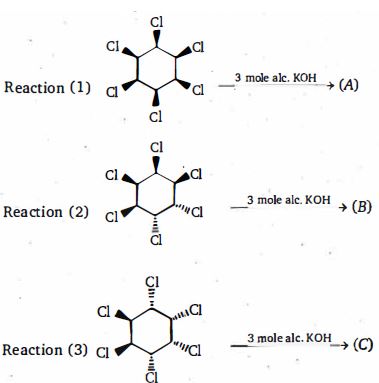
Product obtained in above reactions $(1), (2)$ & $(3)$ is
Isoelectric point is a
What is the mole fraction of the solute in a $1.00\, m$ aqueous solution ?