MCQ
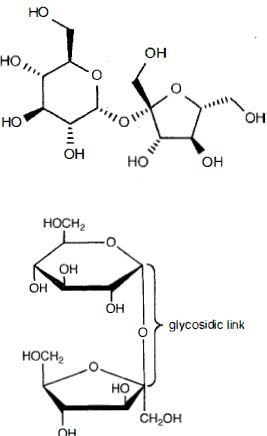
Glycosidic linkage is actually an
  • A
    Carbonyl bond
  • Ether bond
  • C
    Ester bond
  • D
    Amide bond

Answer

Correct option: B.
Ether bond
b
Glycosidic linkage is actually an ether bond as the linkage forming the rings in an oligosaccharide or polysaccharide is not just one bond, but the two bonds sharing an oxygen atom e.g. sucrose

Need a full question paper?

Generate a complete, print-ready paper with questions like this in minutes — across 16+ boards, with answer keys.

Start Generating Free

Similar questions

$CH_3CHO \xrightarrow{{LiAl{H_4}}} CH_3CH_2OH$

Nucleophile added in this reaction

When sugar ' $X$ ' is boiled with dilute $H _{2} SO _{4}$ in alcoholic solution, two isomers ' $A$ ' and ' $B$ ' are formed. $'A'$ on oxidation with $HNO _{3}$ yields saccharic acid where as ' $B$ ' is laevorotatory. The compound ' $X$ ' is ....... .
At low concentrations, the statement that equimolal solutions under a given set of experimental conditions have equal osmotic pressure is true for
Which of the following is $\sigma $ and $\pi $ bonded organometallic compound
The major product of the following reaction is
On heating calcium acetate and calcium formate, the product formed is
The rate of a reaction quadruples when temperature changes from $27^{\circ} \mathrm{C}$ to $57^{\circ} \mathrm{C}$. Calculate the energy of activation.

Given $\mathrm{R}=8.314 \mathrm{~J} \mathrm{~K}^{-1} \mathrm{~mol}^{-1}, \log 4=0.6021$

Chemical reactions involve interaction of atoms and molecules. A large number of atoms/molecules (approximately $6.023 \times 10^{23}$ ) are present in a few grams of any chemical compound varying with their atomic/molecular masses. To handle such large numbers conveniently, the mole concept was introduced. This concept has implications in diverse areas such as analytical chemistry, biochemistry, electrochemistry and radiochemistry. The following example illustrates a typical case, involving chemical/electrochemical reaction, which requires a clear understanding of the mole concept.

A $4.0$ molar aqueous solution of $\mathrm{NaCl}$ is prepared and $500 \mathrm{~mL}$ of this solution is electrolysed. This leads to the evolution of chlorine gas at one of the electrodes (atomic mass: $\mathrm{Na}=23, \mathrm{Hg}=200 ; 1$ Faraday $=96500$ coulombs)

$1.$ The total number of moles of chlorine gas evolved is

$(A)$ $0.5$  $(B)$ $1.0$  $(C)$ $2.0$  $(D)$ $3.0$

$2.$  If the cathode is a $\mathrm{Hg}$ electrode, the maximum weight ( $\mathrm{g}$ ) of amalgam formed from this solution is

$(A)$ $200$  $(B)$ $225$  $(C)$ $400$  $(D)$ $446$

$3.$ The total charge (coulombs) required for complete electrolysis is

$(A)$ $24125$  $(B)$ $48250$  $(C)$ $96500$  $(D)$ $193000$

Give the answer question $1,2$ and $3.$

For a certain reaction, $10\%$ of the reactant dissociates in $1\, hour$, $20\%$ of the reactant dissociate in $2\, hour$, $30\%$ of the reactant dissociates in $3\, hour$. Then the units of rate constant is
What is the bond angle in ammonia molecule?