MCQ
Gold-leaf electroscope can be used _______?
- AOnly to detect the presence of charge.
- BTo detect the presence of charge as well as its nature (positive or negative).
- CTo measure the surface charge density.
- DTo measure current.
Explanation:
If the apparatus is initially in contact with some positively charged body and then comes in contact with another charged body and if the divergence increases we can deduce that the second body is also positively charged. If the divergence decreases then the second body must be negatively charged.
Generate a complete, print-ready paper with questions like this in minutes — across 16+ boards, with answer keys.
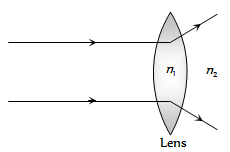
The relation between n1 and n2, if behaviour of light rays is as shown in figure is
|
(a) |
(b) |
(c) |
(d) |
A steady current flows in a metallic conductor of non-uniform cross-section. The quantity/ quantities constant along the length of the conductor is/are
|
(a) Current, electric field and drift speed |
(b) Drift speed only |
|
(c) Current and drift speed |
(d) Current only |
Assertion : The speed of light in a rarer medium is greater than that in a denser medium
Reason : One light year equals to 9.5 × 10¹² km
|
(a) If both assertion and reason are true and the reason is the correct explanation of the assertion. |
|
(b) If both assertion and reason are true but reason is not the correct explanation of the assertion. |
|
(c) If assertion is true but reason is false. |
|
(d) If the assertion and reason both are false. |
The electron in a hydrogen atom makes a transition from an excited state to the ground state. Which of the following statements is true
|
(a) Its kinetic energy increases and its potential and total energies decrease |
|
(b) Its kinetic energy decreases, potential energy increases and its total energy remains the same |
|
(c) Its kinetic and total energies decrease and its potential energy increases |
|
(d) Its kinetic, potential and total energies decreases |
For a thermocouple, the temperature of inversion is that temperature at which thermo e.m.f. is
|
(a) Zero |
(b) Maximum
|
(c) Minimum |
(d) None of the above |


