MCQ
Group comprising of all metals is
  •  $IIA$
  • B
    $IVA$
  • C
    $VIIA$
  • D
    $IIIA$

Answer

Correct option: A.
 $IIA$
a
$(d)$ In $IIA$ group all elements are metal while in $IIIA, IVA$ and $VIIA$ groups non-metallic elements are also present.

Need a full question paper?

Generate a complete, print-ready paper with questions like this in minutes — across 16+ boards, with answer keys.

Start Generating Free

Similar questions

In which of the following processes energy is absorbed?
The enthalpy changes at $298\, K$ in successive breaking of $O -H$ bonds of $HOH$ are-
$H_2O (g) \to H(g) + OH (g), \Delta H = 498\, kJ \,mol^{-1}$
$OH (g) \to H(g) + O (g), \Delta H = 428\, kJ\, mol^{-1}$
The bond enthalpy of the $O-H$ bond is.....$kJ\, mol^{-1}$
The equivalent weight of a metal is $4.5$ and the molecular weight of its chloride is $80$. The atomic weight of the metal is
Aqueous solution of an acid is characterised by the presence of
Accepting the definition that an acid is a proton donor, the acid in the following reaction

$N{H_3} + {H_2}O \to NH_4^ + + O{H^ - }$ is
If in Bohr's model, for unielectronic atom, time period of revolution is represented as $T_{n,Z}$ where $n$ represents shell no. and $Z$ represents atomic number then the value of $T_{1,2} : T_{2,1}$ will be
If $D_T$ and $D_0$ are the theoretical and observed vapour densities at a definite  temperature and $\alpha$ be the degree of dissociation of a substance. Then, $\alpha$ in  the terms of $D_0, D_T$ and $n$ (number of moles of product formed from $1 \,mole$ reactant) is calculated by the formula
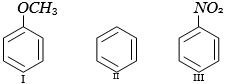
Among the following compounds $(I-III)$ the correct order of reaction with electrophilic reagent is
$\text{PCl}_5(\text{g})\rightleftharpoons\text{PCl}_3(\text{g}),$ if the degree of dissociation is a at equilibrium pressure$ 'p',$ then the equilibrium constant for the reaction is:
Given reaction is $2{X_{(gas)}} + {Y_{(gas)}}$ $\rightleftharpoons$ $2{Z_{(gas)}} + 80\,kcal$ Which combination of pressure and temperature gives the highest yield of $Z$ at equilibrium