MCQ
${H_2}{O_2}$ is used as
  • A
    An oxidant only
  • B
    A reductant only
  • C
    An acid only
  • An oxidant, a reductant and an acid

Answer

Correct option: D.
An oxidant, a reductant and an acid
d
it’s obvious.

Need a full question paper?

Generate a complete, print-ready paper with questions like this in minutes — across 16+ boards, with answer keys.

Start Generating Free

Similar questions

In which one of the following pairs the central atoms exhibit $\mathrm{sp}^2$ hybridization ?
$0.01$ mole of iodoform $(CHI_3)$ reacts with $Ag$ to produce a gas whose volume at  $NTP$ is  ............. $\mathrm{mL}$

$2CHI_3 + 6Ag \to 6AgI(s) + C_2H_2(g)$

Choose the chain terminating step

(1)${H_2} \to {H^ \bullet } + {H^ \bullet }$

(2)$B{r_2} \to B{r^ \bullet } + B{r^ \bullet }$

(3)$B{r^ \bullet } + HBr \to {H^ \bullet } + B{r_2}$

(4)${H^ \bullet } + B{r_2} \to HBr + B{r^ \bullet }$

(5)$B{r^ \bullet } + B{r^ \bullet } \to B{r_2}$

The density of ' $x$ ' $\mathrm{M}$ solution (' $\mathrm{x}$ ' molar) of $\mathrm{NaOH}$ is $1.12 \mathrm{~g} \mathrm{~mL}^{-1}$. while in molality, the concentration of the solution is $3 \mathrm{~m}$ ( $3 \mathrm{molal})$. Then $\mathrm{x}$ is

(Given : Molar mass of $\mathrm{NaOH}$ is $40 \mathrm{~g} / \mathrm{mol}$ )

Aqueous solution of sodium salt of $2-$ methyl butanedioic acid on kolbe's electrolysis gives
Molarity of a solution containing $1\,g\,\,NaOH$ in $250\,ml$ of solution is ...... $M$.
Which of the following element has highest metallic character

Element $- IP$

The heat of transition $(\Delta {H_t})$ of graphite into diamond would be, where$C({\rm{graphite}}) + {O_2}(g) \to C{O_2}(g);\,\,\Delta H = x\,kJ$ $C({\rm{diamond}})\, + {O_2}(g) \to C{O_2}(g);\,\,\Delta H = y\,kJ$
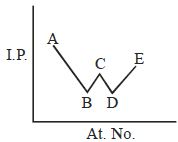
If $A$ to $E$ are element of a group from top to bottom then group can be
Compound $\mathrm{A}, \mathrm{C}_{8} \mathrm{H}_{10} \mathrm{O},$ is found to react with $\mathrm{NaOI}$ (produced by reacting $Y$ with $NaOH$) and yields a yellow precipitate with characteristic smell.

$\mathrm{A}$ and $\mathrm{Y}$ are respectively