MCQ
${H_2}S$ reacts with halogens, the halogens
  • A
    Form sulphur halides
  • B
    Are oxidised
  • Are reduced
  • D
    None of these

Answer

Correct option: C.
Are reduced
(c)${H_2}S + {X_2}(Cl,\,Br,\,I\, = X) \to 2HX + S$. Here the halogen are reduced.

Need a full question paper?

Generate a complete, print-ready paper with questions like this in minutes — across 16+ boards, with answer keys.

Start Generating Free

Similar questions

The pair(s) of coordination complexes/ions exhibiting the same kind of isomerism is(are)

$(A)$ $\left[ Cr \left( NH _3\right)_5 Cl ^2 Cl _2\right.$ and $\left[ Cr \left( NH _3\right)_4 Cl _2\right) Cl$

$(B)$ $\left[ Co \left( NH _3\right)_4 Cl _2\right]^{+}$and $\left[ Pt \left( NH _3\right)_2\left( H _2 O \right) Cl \right]^{+}$

$(C)$ $\left[ CoBr _2 Cl _2\right]^{2-}$ and $\left[ PtBr _2 Cl _2\right]^{2-}$

$(D)$ $\left[ Pt \left( NH _3\right)_3\left( NO _3\right) Cl\right.$ and $\left[ Pt \left( NH _3\right)_3 Cl \right] Br$
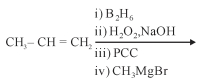
The product formed in the following multistep reaction is:
When $23\, g$ $Na$ reacts with $1\, mole$ of propyne then how many mole of $H_2$ gas will be released......$mole$
Which of the following fact$(s)$ explain$(s)$ as to why $p-$ nitrophenol is more acidic than phenol?

$I$. $-I$ Effect of nitro group.

$II$. Greater resonance effect of $p-$ nitrophenoxy group

$III$. Steric effect of bulky nitro group

What are $A\,\& \,B$ in the following reaction ?

 $\xrightarrow{{Mg/THF}}A\mathop {\xrightarrow{{(i)\,C{H_3}CHO}}}\limits_{(ii)\,aq.N{H_4}Cl} B$

$IUPAC$ name of $C{H_3} - CH = CH - C \equiv CH$ is
For a sample of perfect gas when its pressure is changed isothermally from $p_i$ to $p_f$, the entropy change is given by
The amount of $BaSO_4$ formed upon mixing $100\,mL$ of $20.8\%$ $BaCl_2$ solution with $50\,mL$ of $9.8\%$ $H_2SO_4$ solution will be ............. $\mathrm{g}$

( $Ba = 137,\,\,Cl = 35.5,\,\,S = 32,\,\,H = 1$ and $O = 16$ )

Calculate the equilibrium constant for the reaction $H_2(g) + CO_2(g) \rightleftharpoons H_2O(g) + CO(g)$ at $1395 \,K$ by using following datas

$2H_2O(g) \rightleftharpoons 2H_2(g) + O_2(g); K_1 = 2.1 \times 10^{-13}$

$2CO_2(g) \rightleftharpoons 2CO(g) + O_2(g); K_2 = 1.4 \times 10^{-12}$

Which of the following is an ideal solution