MCQ
${H_2}S$ reacts with halogens, the halogens
  • A
    Form sulphur halides
  • B
    Are oxidised
  • Are reduced
  • D
    None of these

Answer

Correct option: C.
Are reduced
(c)${H_2}S + {X_2}(Cl,\,Br,\,I\, = X) \to 2HX + S$. Here the halogen are reduced.

Need a full question paper?

Generate a complete, print-ready paper with questions like this in minutes — across 16+ boards, with answer keys.

Start Generating Free

Similar questions

The electrophile, $E^+$ attacks the benzene ring to generate the intermediate $\sigma -$ complex. Which $\sigma -$ complex is of lowest energy ?
Which of the following compound have wrong $IUPAC$ name
Which of the following compounds will exhibit geometrical isomerism
Which of the following facts given is not correct ?
$(I)$ Bond length order : $H^-_2 = H^+_2 > H_2$

$(II)\, O^+_2 ,NO,N^-_2$ have same bond order of $2 \frac{1}{2}$

$(III)$ Bond order can assume any value including zero upto four

$(IV)\, NO^-_3$ and $BO^-_3$ have same bond order for $X - O$ bond (where $X$ is central atom)

The $IUPAC$ name of the compoundis

$\begin{array}{*{20}{c}}
  {C{H_3} - C = C{H_2}C{H_2}OH} \\ 
  {|\,\,\,\,\,\,\,\,\,\,\,\,\,\,\,\,\,\,\,\,\,\,} \\ 
  {\,C{H_3}\,\,\,\,\,\,\,\,\,\,\,\,\,\,\,\,} 
\end{array}$ is
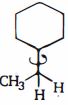
The lowest energy conformer of is
Relation between $(B)$ and $(C)$ is

$C{H_3} - C \equiv C - H\xrightarrow{{NaN{H_2}}}\xrightarrow{{C{H_3} - I}}(A)\xrightarrow{{Li/liq\,N{H_2}}}(B)$

$C{H_3} - C \equiv C - H\xrightarrow{{NaN{H_2}}}\xrightarrow{{C{H_3} - I}}(A)\xrightarrow[{Pd.CaC{O_3}}]{{{H_2}}}(C)$

Percentage composition of an organic compounds is as follows: $C = 10.06$, $H = 0.84$, $Cl = 89.10$. Which of the following corresponds to its molecular formula if the vapour density is $ 60.0$
$XeF_{2(g)} + H_{2(g)} \to 2HF_{(g)} + Xe_{(g)}\, \Delta H^o = -430\, kJ$
Bond energy $\to H-H = 435\, kJ/mol$

                     $\to H-F = 565\, kJ/mol$
Calculate average bond energy of $Xe-F$ bond.....$ kJ/mol$

In equilibrium $C{H_3}COOH + {H_2}O$ $\rightleftharpoons$ $C{H_3}COO + H_3 O^ +$ The equilibrium constant may change when