Question
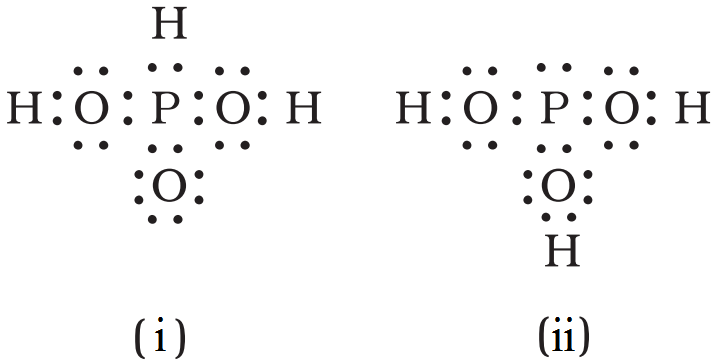
H3 PO3 can be represented by structures 1 and 2 shown below. Can these two structures be taken as the canonical forms of the resonance hybrid representing H3 PO3? If not, give reasons for the same.
Answer

These two cannot be called as canonical forms as relative position of hydrogen is changed. In resonance, canonical forms should differ only in the position of electrons and not in the position of atoms.

Need a full question paper?

Generate a complete, print-ready paper with questions like this in minutes — across 16+ boards, with answer keys.

Start Generating Free

Similar questions

$\text{N}_2(\text{g})+3\text{H}_2(\text{g})\rightleftharpoons2\text{NH}_3(\text{g});$
$\text{K}=0.50\text{ at }673\text{K.}$
Write the equilibrium expression and equilibrium constant for reverse reaction.
Justify the given statement with suitable examples- “The Properties of the elements are a periodic function of their atomic numbers”.
Calculate volume $CO _2$ gas at NTP obtained by complete combustion of 500 ml ethyne $\left( C _2 H _2\right)$.
Describe the theory associated with the radius of an atom as it.
loses an electron.
Use the periodic table to answer the following questions.
Identify an element that would tend to gain two electrons.
Identify the redox reactions out of the following reactions and identify the oxidising and reducing agents in them.
$3\text{HCl(aq)}+\text{HNO}_3\text{(aq)}\xrightarrow{ \ \ \ \ \ \ \ \ }\text{Cl}_2\text{(g)}+\text{NOCl}(\text{g})+2\text{H}_2\text{O(l)}$
In following compound calculate the hybridisation in each carbon.
(i) $CH _3 Cl$
(ii) $H C O N H _2$
(iii) $CH _3 CN$
Calculate the heat of combustion of glucose from the following data:

$\text{C(graphite)}+\text{O}_2(\text{g})\overrightarrow{\ \ \ \ \ }\text{CO}_2(\text{g});$ $\Delta\text{H}=-395.0\text{kJ mol}^{-1}$

$\text{H}_2(\text{g})+\frac{1}{2}\text{O}_2(\text{g})\overrightarrow{\ \ \ \ \ \ \ }\text{H}_2\text{O(l)};$ $\Delta\text{H}=-269.4\text{kJ mol}^{-1}$

$6\text{C(graphite)}+6\text{H}_2(\text{g})+\text{O}_2(\text{g})\overrightarrow{\ \ \ \ \ \ }\text{C}_6\text{H}_{12}\text{O}_6(\text{s});$ $\Delta\text{H}=-1169.8\text{kJ mol}^{-1}$

What is oxidation state of Cr in [Cr(H2O)6]Cl3