MCQ
$HCl$ is a gas, but $HF$ is a low boiling liquid. This is because
  • A
    $H - F$ bond is strong
  • B
    $H - F$ bond is weak
  • The molecules aggregate because of hydrogen bonding in $HF$
  • D
    $HF$ is a weak acid

Answer

Correct option: C.
The molecules aggregate because of hydrogen bonding in $HF$
c
$H - F$ is a liquid at room temperature while $HCl$ is a gas. This is due to extensive $H$-bonding in $H$ - $F$ which increases its boiling point.

Need a full question paper?

Generate a complete, print-ready paper with questions like this in minutes — across 16+ boards, with answer keys.
Start Generating Free

Similar questions

If a steady current of $4\, amp$ maintained for $40$ minutes, deposits $4.5\, gm$ of zinc at the cathode and then the electro chemical equivalent will be
$Pt\,(s)\,|\,\mathop {{H_2}(g)}\limits_{1\,atm} \,|\,{H^ + }\,({P^H} = 2)\,||\,{H^ + }\,({P^H} = 3)\,|\,\mathop {{H_2}(g)}\limits_{1\,atm} \,|\,Pt\,(s)$ cell reaction will be
Hot conc. $\mathrm{H}_2 \mathrm{SO}_4$ acts as moderately strong oxidising agent. It oxidises both metals and nonmetals. Which of the following element is oxidised by conc. $\mathrm{H}_2 \mathrm{SO}_4$ into two gaseous products?
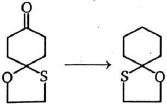
Above conversion can be achieved by
Fats and oils are mixture of
Which of the following xenon compound has the same number of lone pairs as in $I_3^-$ ?
Which one of the following chemical agent is not being used for dry-cleaning of clothes?
The conductance of a $0.0015 \mathrm{M}$ aqueous solution of a weak monobasic acid was determined by using a conductivity cell consisting of platinized $\mathrm{Pt}$ electrodes. The distance between the electrodes is $120 \mathrm{~cm}$ with an area of cross section of $1 \mathrm{~cm}^2$. The conductance of this solution was found to be $5 \times 10^{-7} \mathrm{~S}$. The $\mathrm{pH}$ of the solution is $4$ . The value of limiting molar conductivity $\left(\Lambda_{\mathrm{m}}^0\right)$ of this weak monobasic acid in aqueous solution is $\mathrm{Z} \times 10^2 \mathrm{~S} \mathrm{~cm}^{-1} \mathrm{~mol}^{-1}$. The value of $\mathrm{Z}$ is
Which of the following is pyrimidine base?
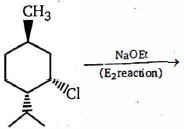
Major product of the reaction is