Question
Heart is called a pump.

Answer

  1. The heart acts as a pumping organ. It shows continuous pumping action.
  2. The rhythmic contraction or systole and relaxation or diastole of heart forms one heartbeat.
  3. Such heartbeats occur about 72 times per minute.
  4. The heart efficiently pumps about 5 litres of blood per minute. Therefore, the heart is called a pump.

Need a full question paper?

Generate a complete, print-ready paper with questions like this in minutes — across 16+ boards, with answer keys.
Start Generating Free

Similar questions

Explain the stages in sexual reproduction of an organism. Mention what major events occur in each of them.
Ramesh visited a National Park on a school trip where he saw tiger eating a deer. He got disturbed and asked his teacher why is he doing so. His teacher replied that it is natural population controlling phenomenon.
  1. Which type of interspecific interaction is found between tiger and deer?
  2. State the role of predators.
  3. What other type of population interactions are seen in nature?
  4. State the values of Ramesh towards animals.
Explain the contribution of Alfred Sturtevant in ‘Chromosome mapping’.
Cerebrum and cerebellum
  1. Draw a diagram of a mature embryo sac of an angiosperm and label the following parts in it:
  1. Filiform apparatus.
  2. Synergids.
  3. Central cell.
  4. Egg cell.
  5. Polar nuclei.
  6. Antipodals.
  1. Write the fate of egg cell and polar nuclei after fertilisation.
Represent schematically the life cycle of a malarial parasite.
Describe about the physiological effects and applications of cytokinin.
Give importance of hypothalamus.
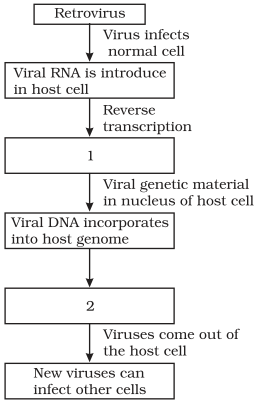
In the given flow diagram, the replication of retrovirus in a host is shown. Observe and answer the following questions,
  1. Fill in (1) and (2).
  2. Why is the virus called retrovirus?
  3. Can the infected cell survive while viruses are being replicated and released?
Explain the following parts of male reproductive system along with labelled diagram showing these parts – Testis, vasa deferentia, epididymis, seminal vesicle, prostate gland and penis.
OR
With the help of a neat, labelled diagram, describe the human male reproductive system.