Question
Heat is being supplied to a system but the system does not perform any external work. Is it possible? If yes, how?

Answer

Yes, it is possible. If total quantity of heat $\Delta\text{Q}$ supplied to a system is retained by it as its increase in internal energy $\Delta\text{U}$ i.e., $\Delta\text{Q}-\Delta\text{U,}$ then the external work done by the system AW is zero. Isochoric process is an example of this type of process.

Need a full question paper?

Generate a complete, print-ready paper with questions like this in minutes — across 16+ boards, with answer keys.
Start Generating Free

Similar questions

Can the relative velocity of one moving object be zero compared to another moving object? Give any example.
Explain why :
The climate of a harbour town is more temperate than that of a town in a desert at the same latitude.
Read each statement below carefully and state, with reasons and examples, if it is true or false:
A scalar quantity is one that
Must be dimensionless.
What is the average velocity of molecules of a gas in equilibrium?
The linear momentum of a car and a truck are equal. Which of the two will have greater speed?
Water is slowly coming out from a vertical pipe. As the water descends after coming out, its area of cross-section reduces. Explain this on the basis of the equation of continuity.
If the acceleration of a particle simple $a=\left(-\frac{p}{q}\right) x$ harmonic motion is given, then what will be the time period of this particle?
Is it possible to heat a body without providing heat energy? How?
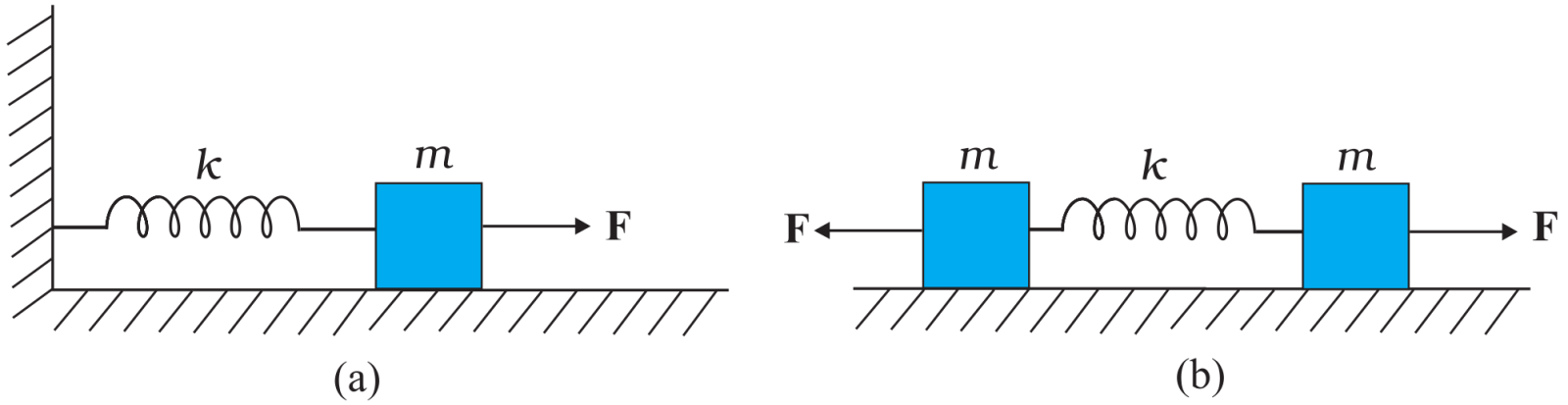
Figure (a) shows a spring of force constant k clamped rigidly at one end and a mass m attached to its free end. A force F applied at the free end stretches the spring. Figure (b) shows the same spring with both ends free and attached to a mass m at either end. Each end of the spring in Fig. (b) is stretched by the same force F.

What is the maximum extension of the spring in the two cases?

A stone is fastened to one end of a string and is whirled in a vertical circle of radius R. Find the minimum speed the stone can have at the highest point of the circle.