MCQ
Heaviest particle is
  • A
    Meson
  • Neutron
  • C
    Proton
  • D
    Electron

Answer

Correct option: B.
Neutron
b
(b) Mass of neutron is greater than that of proton, meson and electron.
Mass of neutron = mass of proton + mass of electron

Need a full question paper?

Generate a complete, print-ready paper with questions like this in minutes — across 16+ boards, with answer keys.
Start Generating Free

Similar questions

Amongst the following ions, which one has the highest paramagnetism ?
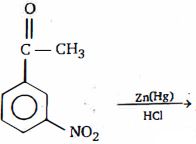
Product of the Clemmensen reduction is
Which of the following molecules does not have co- ordinate bonds?
A salt $MX$ has $K_{sp} = 4 × 10^{-10}$ . What value of $K_{sp}$ must another salt $MX_3$ have if the molar solubility of the two salts is to be identical 
Most acidic is
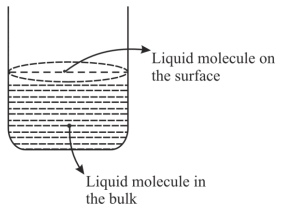
Based on the given figure, the number of correct statement/s is/are $........$.

$A.$ Surface tension is the outcome of equal attractive and repulsion forces acting on the liquid molecule in bulk.

$B.$ Surface tension is due to uneven forces acting on the molecules present on the surface.

$C.$ The molecule in the bulk can never come to the liquid surface.

$D.$ The molecules on the surface are responsible for vapour pressure if the system is a closed system.
What is the product of following reaction ?

$Hex - 3 - ynal\xrightarrow[\begin{subarray}{l} 
  (ii)\,PB{r_3} \\ 
  (i)\,Mg/ether \\ 
  (i)\,C{O_2}/{H_3}{O^ + } 
\end{subarray} ]{{(i)\,NaB{H_4}}}\,?$

Acetic acid will be obtained on oxidation of
The molal elevation constant of water $ = {0.52\,^o}C$. The boiling point of $1.0$  molal aqueous $KCl$ solution (assuming complete dissociation of $KCl$), therefore, should be ......... $^oC$
When $1.685$ gram of an alkali metal chloride is dissolved in $200$ gram water, the boiling point of the solution is measured to be $100.051\,^o C$. If the ionic solid has a crystal lattice with cation and anion radius $1.70\,\mathop A\limits^o $ and $1.80\,\mathop A\limits^o $ respectively. Find the edge length of solid assuming no defect in the cyrstal -

Given : $K_b(H_2O) = 0.51\, Kkg \,mol^{-1}$

            $N_A = 6 × 10^{23}$

             $[Li = 7, \,\,Na = 23$,  $K = 39,\,\, Rb = 85.5$ , $Cs = 133, \,\,Cl = 35.5]$