MCQ
Highest stable $Mn$ fluoride is $MnF_4$ where as highest $Mn$ oxide is $Mn_2O_7$ due to
  • A
    $O$ atom is smaller the $F$.
  • Oxygen has ability to form multiple bonds
  • C
    $Mn^{7+}$ does not exist
  • D
    $F$ can not-stabilise higher oxidation states

Answer

Correct option: B.
Oxygen has ability to form multiple bonds
b

Need a full question paper?

Generate a complete, print-ready paper with questions like this in minutes — across 16+ boards, with answer keys.
Start Generating Free

Similar questions

For the reaction $A + 2B \rightarrow C + D,$ the rate law is given by $r = k[A] [B]^2,$ the concentration of $A$ is kept constant while that of $B$ is doubled. The rate of the reaction will$:$
The reaction of $Xe$ with an excess of $F-2$​ at high pressure and $573K$ yields:
Equal volume of $0.2\, M$ urea and $0.2\, M$ glucose are mixed. The mixture will have
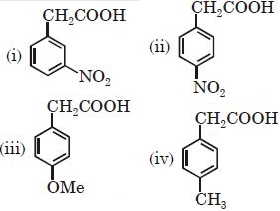
The order of reactivity of following compounds towards sodalime decarboxylation reaction ?
Which of the following is in the increasing order of the ionic character
If the ratio of the coordination number of $A$ to that of $B$ is $x:y,$ then the ratio of number of atoms of $A$ to that of $B$ in the unit cell is:
Treatment of propionaldehyde with dilute $NaOH$ solution gives
The concentration of potassium ions inside a biological cell is at least twenty times higher than the outside. The resulting potential difference across the cell is important in several processes such as transmission of nerve impulses and maintaining the ion balance. A simple model for such a concentration cell involving a metal $\mathrm{M}$ is:

$\mathrm{M}(\mathrm{s}) \mid \mathrm{M}^{+}$(aq; $0.05$ molar) || $\mathrm{M}^{+}(\mathrm{aq}), 1$ molar) $\mid \mathrm{M}(\mathrm{s})$

For the above electrolytic cell the magnitude of the cell potential $\left|E_{\text {cell }}\right|=70 \mathrm{mV}$.

$1.$ For the above cell

$(A)$ $\mathrm{E}_{\text {cell }}<0 ; \Delta \mathrm{G}>0$ $(B)$ $\mathrm{E}_{\text {cell }}>0 ; \Delta \mathrm{G}<0$

$(C)$ $\mathrm{E}_{\text {cell }}<0 ; \Delta \mathrm{G}^{\circ}>0$ $(D)$ $\mathrm{E}_{\text {cell }}>0 ; \Delta \mathrm{G}^{\circ}>0$

$2.$ If the $0.05$ molar solution of $\mathrm{M}^{+}$is replaced by $0.0025$ molar $\mathrm{M}^{+}$solution, then the magnitude of the cell potential would be

$(A)$ $35 \mathrm{mV}$ $(B)$ $70 \mathrm{mV}$ $(C)$ $140 \mathrm{mV}$ $(D)$ $700 \mathrm{mV}$

Give the answer question $1,2.$ 

Which of the following is a mixed ether?
Which one of the following sets of monosaccharides forms sucrose?