Question
hoose the correct statement from the following:

Answer

  1. Lines of electric field point towards regions of lower potential.
Explanation:
If the lines cross each other at a given location, then there must be two distinctly different values of electric field with their own individual direction at that given location. This could never be the case. Therefore the lines representing the field cannot cross each other at any given location.
Electric field end at a negative charge.
Along the electric field line potential drops.

Need a full question paper?

Generate a complete, print-ready paper with questions like this in minutes — across 16+ boards, with answer keys.
Start Generating Free

Similar questions

The focal length of the objective of a compound microscope if $f_o$ and its distance from the eyepiece is $L.$ The object is placed at a distance $u$ from the objective. For proper working of the instrument:
The torque ($\vec{\tau}$) experienced by a current loop of magnetic momvent $(\overrightarrow{ M })$ placed in magnetic field $\vec{B}$ is :
When an unpolarized light of intensity $\mathrm{I}_0$ is incident on a polarizing sheet, the intensity of the light which does not get transmitted is
To increase the angular magnification of a simple microscope, one should increase:
An electron rotating in a circular path of radius r making n revolutions per second. Magnetic moment of electron will be:
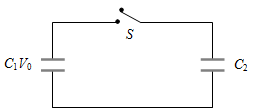
A capacitor of capacity $C_1$ is charged to the pointurill File successfully uploaded. $x$, it is connected with a capacitor of capadity $C _2$ as shown in the adjoining figure. The ratio of energies before and after the connection of switch $S$ will be
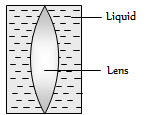
Shown in the figure here is a convergent lens placed inside a cell filled with a liquid. The lens has focal length $+ 20 \ cm$ when in air and its material has refractive index $1.50.$ If the liquid has refractive index $1.60,$ the focal length of the system is
The focal length of a concave mirror is 10 cm. On placing an object at 10 cm in front of the mirror, its image will be formed:
The intensity of electric field at a point between the plates of a charged capacitor(a) Is directly proportional to the distance between the plates(b) Is inversely proportional to the distance between the plates(c) Is inversely proportional to the square of the distance between the plates(d) Does not depend upon the distance between the plates


Two nuclei have their mass numbers in the ratio of 1:27. The ratio of their nuclear densities are-