Question
How are carboxylic acids prepared from the following compounds? Explain with examples:
(a) Primary alcohol
(b) Acyl halide
(c) Acid anhydride
(d) Grignard reagent
(e) Alkyl benzene.
Answer

self

Need a full question paper?

Generate a complete, print-ready paper with questions like this in minutes — across 16+ boards, with answer keys.

Start Generating Free

Similar questions

With the help of a labelled diagram show that there are four octahedral voids per unit cell in a cubic close packed structure.
A voltaic cell is set up at $25°C$ with the following half-cells $Al^{3+} (0.001M)$ and $Ni^{2+} (0.50M)$. Write an equation for the reaction that occurs when the cell generates an electric current and determine the cell potential. $(\text{Given:}\text{ E}^{\circ}_{\text{Ni}^{2+}/\text{Ni}}=-0.25\text{V,E}^{\circ}_{\text{Al}^{3+}/\text{Al}}=-1.66\text{V})$
A hydrocarbon 'A', $\left(\mathrm{C}_4 \mathrm{H}_8\right)$ on reaction with HCl gives a compound ' B ', $\left(\mathrm{C}_4 \mathrm{H}_9 \mathrm{Cl}\right)$, which on reaction with 1 mol of $\mathrm{NH}_3$ gives compound ' C ', ( $\left.\mathrm{C}_4 \mathrm{H}_{11} \mathrm{~N}\right)$. On reacting with $\mathrm{NaNO}_2$ and HCl followed by treatment with water, compound ' C ' yields an optically active alcohol,'D'. Ozonolysis of 'A' gives 2 mols of acetaldehyde. Identify compounds 'A' to 'D'. Explain the reactions involved.
Derive the integral rate equation for the first order reaction and prove that the graph of $\ln k$ and $t$ a straight line.
Answer the following questions: Give chemical reactions for the following observations:
  1. Potassium permanganate is a good oxidising agent in basic medium.
  2. Inter convertibility of chromate ion and dichromate ion in aqueous solution depends upon pH of the solution.
  3. Potassium permanganate is thermally unstable at 513K.
  1. Describe the general trends in the following properties of the first series of the transition elements:
  1. Stability of +2 oxidation state.
  2. Formation of oxometal ions.
  1. Assign reason for each of the following:
  1. Transition elements exhibit variable oxidation states.
  2. Transition metal ions are usually coloured.
How does colour appear in coordination compounds? Its explanation is based on crystal field theory.

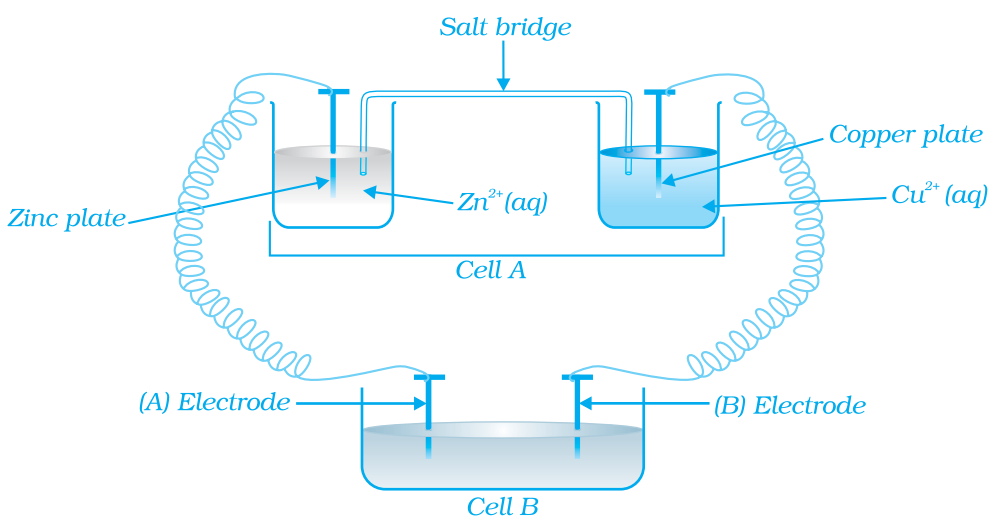
Consider the and answer the following questions.

i. Cell 'A' has $E_{\text {Cell }}=2 \mathrm{~V}$ and Cell 'B' has $E_{\text {Cell }}=1.1 \mathrm{~V}$ which of the two cells ' $A$ ' or ' $B$ ' will act as an electrolytic cell. Which electrode reactions will occur in this cell?
ii. If cell 'A' has $E_{C e l l}=0.5 \mathrm{~V}$ and cell 'B' has $E_{C e l l}=1.1 \mathrm{~V}$ then what will be the reactions at anode and cathode?
Match the items of Columns I and II and mark the correct option.
  Column I   Column II
$(A)$ Its partial hydrolysis does not change oxidation state of central atom $(1)$ $He$
$(B)$ It is used in modern diving apparatus $(2)$ $XeF_6$
$(C)$ It is used to provide inert atmosphere for filling electrical bulbs $(3)$ $XeF_4$
$(D)$ Its central atom is in $sp^3d^2$ hybridisation $(4)$ $Ar$
  1. $A (1) B (4) C (2) D (3)$
  2. $A (1) B (2) C (3) D (4)$
  3. $A (2) B (1) C (4) D (3)$
  4. $A (1) B (3) C (2) D (4)$
Match the items of Column I and Column II.
 
Column I
 
Column II
i.
Lechlanche cell
a.
Cell reaction $2H_2 + O_2 ⎯→ 2H_2O$
ii.
Ni–Cd cell
b.
Does not involve any ion in solution and is used in hearing aids.
iii.
Fuel cell
c.
Rechargeable.
iv.
Mercury cell
d.
Reaction at anode, $Zn ⎯→ Zn^{2+} + 2e^-$
 
 
e.
Converts energy of combustion into electrical energy.