Question
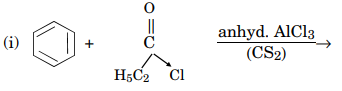
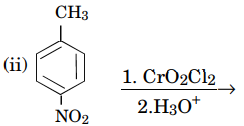
How are carboxylic acids prepared from the following compounds? Explain with examples:
(a) Primary alcohol
(b) Acyl halide
(c) Acid anhydride
(d) Grignard reagent
(e) Alkyl benzene.
Answer

self

Need a full question paper?

Generate a complete, print-ready paper with questions like this in minutes — across 16+ boards, with answer keys.

Start Generating Free

Similar questions

What are the classification of proteins on the basis of molecular shape?
Explain the open chain structure of glucose.
What is meant by stability of a coordination compound in solution? State the factors which govern stability of complexes.
$\ce{COSO_4Cl.5NH_3}$ exists in two isomeric forms $‘A’$ and $‘B’$. Isomer $‘A’$ reacts with $\ce{AgNO_3}$ to give white precipitate, but does not react with $\ce{BaCl_2.}$ Isomer $‘B’$ gives white precipitate with $\ce{BaCl_2} $ but does not react with $\ce{AgNO_3}$. Answer the following questions.
  1. Identify $‘A’$ and $‘B’$ and write their structural formulas.
  2. Name the type of isomerism involved.
  3. Give the $\text{IUPAC}$ name of $‘A’$ and $‘B’.$
Vapour pressures of pure acetone and chloroform at 328 K are 741.8 mm Hg and 632.8 mm Hg respectively. Assuming that they form ideal solution over the entire range of composition, plot $p_{\text {total }}, p_{\text {chloroform }}$ and $p_{\text {acetone }}$ as a function of $x_{\text {acetone }}$ The experimental data observed for different compositions of mixture is :
$100 \times x_{\text {acetone }}$011.823.436.050.858.264.572.1
$p_{\text {acetone }} / mm Hg$054.9110.1202.4322.7405.9454.1521.1
$p_{\text {chloroform }} / mm Hg$632.8548.1469.4359.7257.7193.6161.2120.7
Plot this data also on the same graph paper. Indicate whether it has positive deviation or negative deviation from the ideal solution.
In the reaction
$Q + R \rightarrow$ Products
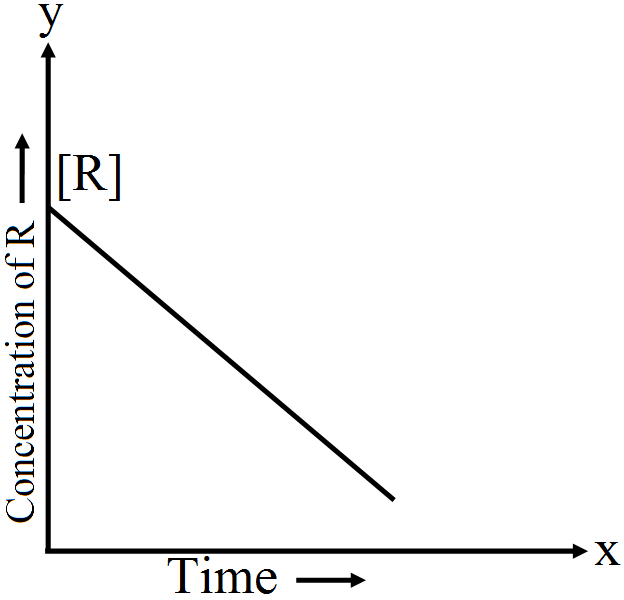
The time taken for $99\%$ reaction of $Q$ is twice the time taken for $90\%$ reaction of $R.$ The concentration of $R$ varies with time as shown in the figure given alongside.

What is the overall order of the reaction? Give the units of the rate constant for the same. Write the rate expression for the above reaction.
Explain the relationship between basicity and structure of amines.
  1. How is the variability in oxidation states of transition metals different from that of the $p-$block elements?
  2. Out of $Cu^+$ and $Cu^{2+}$, which ion is unstable in aqueous solution and why?
  3. Orange colour of $Cr_2O_7^{2–}$ ion changes to yellow when treated with an alkali. Why?
  4. Chemistry of actinoids is complicated as compared to lanthanoids. Give two reasons.
Match the catalysts given in Column $I$ with the processes given in Column $II.$
 
Column $I ($Catalyst$)$
 
Column $II ($Process$)$
$(i)$
Ni in the presence of hydrogen
$(a)$
Zieglar Natta catalyst
$(ii)$ $Cu_2Cl_2$ $(b)$
Contact process
$(iii)$ $V_2O_5$ $(c)$
Vegetable oil to ghee
$(iv)$
Finely divided iron
$(d)$
Sandmeyer reaction
$(v)$ $TiCl_4 + Al (CH_3)_3$ $(e)$
Haber’s Process
 
 
$(f)$
Decomposition of $KClO_3$