Question
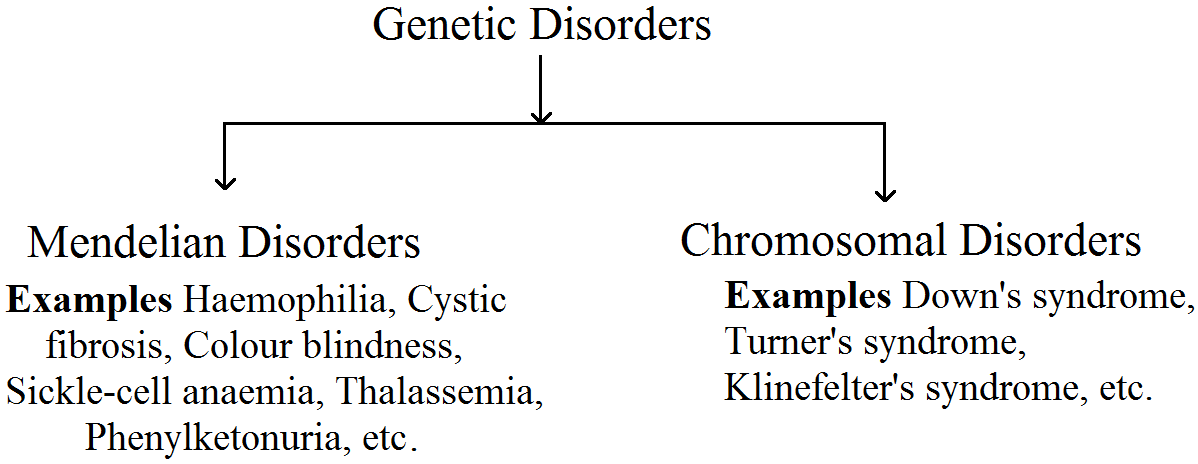
How are genetic disorders broadly classified? Differentiate between them. Explain by giving one example for each.
Answer

These are disorders or illness caused by one or more abnormlities in the autosomes or sex chromosomes of the person. Thus, referred to as autosomal disorders or sex-linked disorders, respectively.
The generic disorders are divided into:

Differentiate between Mendelian and Chormosomal disorders are:
S.No.
Mendelian disorders
Chormosomal disorders
(i)
The disorders are caused by allelic abnormalities.
The disorders are caused by chromosomal abnormalities
(ii) 
Allelic abnormalities develop due to mutations.
Chromosomal abnormalities develop due to defective synapsis and disjunction.
(iii)
The defect can be predicted through pedigree analysis.
The defect can be known through amniocentesis.
(iv)
The disorder is transmitted to the progeny.
The disorder is rarely transmitted.
(v) 
Examples: Haemophilia, Cystic fibrosis, Colour blindness, Sickle-cell anaemia, Thalassemia, Phenylketonuria, etc.
Examples: Down's syndrome, Turner's syndrome, Klinefelter's syndrome, etc.

Need a full question paper?

Generate a complete, print-ready paper with questions like this in minutes — across 16+ boards, with answer keys.

Start Generating Free

Similar questions

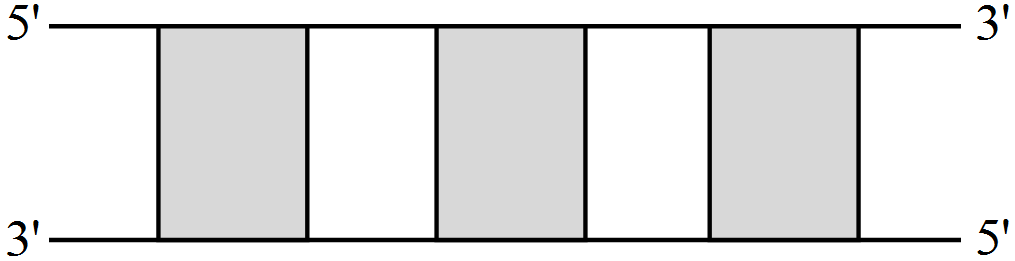
Illustration below is a DNA segment, which constitutes a gene:

  1. Name the shaded and unshaded regions of gene.
  2. Explain how these genes are expressed.
  3. How is this gene different from prokaryotic gene in its expression?
What is population explosion? Discuss the various reason of population explosion.
Describe the structure of a young anther as seen in a transverse section.
What is ecological pyramid? Describe the different types of pyramid.
What is meant by immunity? What are the four barriers to innate immunity? Explain . Draw a labelled diagram of the structure of an antibody molecule.
Using a Punnett Square, workout the distribution of phenotypic features in the first filial generation after a cross between a homozygous female and a heterozygous male for a single locus.
  1. Explain a monohybrid cross taking seed coat colour as a trait in Pisum sativum. Work out the cross upto F2 generation.
  2. State the laws of inheritance that can be derived from such a cross.
  3. How is the phenotypic ratio of F2 generation different in a dihybrid cross?
Enumerate the events in the ovary of a human female during:
Luteal phase of menstrual cycle.
Give a genetic explanation for the following cross. When a tall pea plant with round seeds was crossed with a dwarf pea plant with wrinkled seeds then all the individual of F1-population were tall with round seeds. However selfing among F1-population led to a 9:3:3:1 phenotypic ratio.
Observe the representation of genes involved in the lac operon given below.

  1. Identify the region where the repressor protein will attach normally.
  2. Under certain conditions repressor is unable to attach at this site. Explain.
  3. If repressor fails to attach to the said site what products will be formed by z, y and a?
  4. Analyse why this kind of regulation is called negative regulation.