Question
How are metals refined by the electrolytic process? Describe the electrolytic refining of copper with the help of a neat labelled diagram.

Answer

For the refining of an impure metal by the process of electrolysis, a thick block of impure metal is made anode (connected to +ve terminal of the battery) and a thin strip of the pure metal is made cathode (connected to -ve terminal of battery). A water soluble salt (of the metal to be refined) is taken as electrolyte. On passing current, impure metal dissolves from the anode and goes into the electrolyte solution. And pure metal from the electrolyte deposits on the cathode. Electrolytic refining of copper: In an electrolytic tank, acidified copper sulphate (CuSO4+ dilute H2O4) solution forms the electrolyte. A block of impure copper is made into an anode by connectig the positive terminal of a power supply (battery). A thin strip of highly pure copper metal is the cathode of the cell. The negative terminal of the power supply is connected to it.
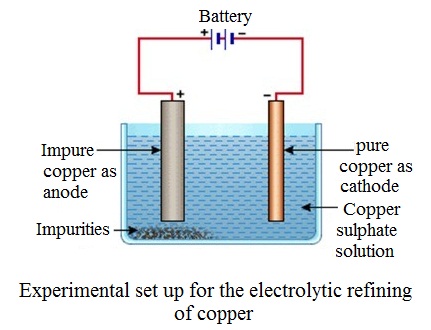
A small electric curr ent is passed through the cell. Atoms from the anode enter the electrolyte. The copper from the anode gets converted into copper sulphide. An equal number of copper atoms from the solution get deposited on the cathode. This is to keep the concentration of the solution constant. Impurities from the anode block either remain in solution or collect below the anode, as they are unable to displace copper form the sulphate solution. The insoluble impurities remain in the electrolyte and are called anode mud. Copper sulphate solution contains ions of Cu2+ and SO42- . The following reactions take
place at the anode and cathode when an electric current is passed.

At cathode : $\underset{\substack{\text { Copper ion } \\ \text {  (From electrolyte)   }}}{ Cu ^{2+} } \xrightarrow[\text { (Reduction) }]{+ \text { 2electrons }} \underset{\substack{\text { Copper atom } \\ \text {  (Deposits on cathode)}}}{ Cu }$
At anode : $\underset{\substack{\text { Copper atom } \\ \text {(From impure anode) }}}{ Cu } \xrightarrow[\text { (oxidation) }]{- \text { 2electrons }} \underset{\substack{\text { Copper ion } \\ \text {(Goes into electrolyte)}}}{ Cu^{+2} }$

Pure copper is scraped or removed from the cathode. Anode becomes thinner as the electrolysis process proceeds. Some important metals like gold and silver are present in the anode mud. These can be recovered separately.


Need a full question paper?

Generate a complete, print-ready paper with questions like this in minutes — across 16+ boards, with answer keys.

Start Generating Free

Similar questions

What are the merits of the modern periodic table of elements?
In the reaction represented by the following equation:
$\text{CuO(s)}\ +\ \text{H}_2(\text{g})\xrightarrow{\ \ \ \ \ \ \ \ \ \ \ \ }\text{Cu(s)}\ +\ \text{H}_2\text{O(1)}$
  1. Name the substance oxidised.
  2. Name the substance reduced.
  3. Name the oxidising agent.
  4. Name the reducing agent
What is meant by refining of a metal? Name the most widely used method for the refining of impure metals obtained by various reduction processes. Describe this method with the help of a labelled diagram by taking the example of any metal.
Properties of the elements are given below. Where would you locate the following elements in the periodic table?
  1. A soft metal stored under kerosene.
  2. An element with variable (more than one) valency stored under water.
  3. An element which is tetravalent and forms the basis of organic chemistry.
  4. An element which is an inert gas with atomic number 2.
  5. An element whose thin oxide layer is used to make other elements corrosion resistant by the process of “anodising”.
Describe the structure of graphite with the help of a labelled diagram.
A metal X forms a salt XSO4. The salt XSO4 forms a clear solution in water which reacts with sodium hydroxide solution to form a blue precipitate Y. Metal X is used in making electric wire and alloys like brass.
  1. What do you think metal X could be?
  2. Write the name, formula and colour of salt XSO4.
  3. What is the blue precipitate Y?
  4. Write a chemical equation of the reaction which takes place when salt XSO4 reacts with sodium hydroxide solution. Give the state symbols of all the reactants and products which occur in the above equation.
  1. Name the following:
  1. Metal that can be cut by knife.
  2. Lustrous non-metal.
  3. Metal that exists in liquid state at room temperature.
  4. Most malleable and ductile metal.
  5. Metal that is best conductor of electricity.
  6. Non-metal that can exist in different forms.
  1. How are alloys better than metals? Give composition of solder and amalgam.
A compound C (molecular formula, C2H4O2) reacts with Na-metal to form a compound R and evolves a gas which burns with a pop sound. Compound C on treatment with an alcohol A in presence of an acid forms a sweet smelling compound S (molecular formula, C3H6O2). On addition of NaOH to C, it also gives R and water. S on treatment with NaOH solution gives back R and A.

Identify C, R, A, S and write down the reactions involved.

Describe how washing soda is produced starting from sodium chloride (common salt). Write equations of all the reactions involved.
A compound X is formed by the reaction of a carboxylic acid C2H4O2 and an alcohol in presence of a few drops of H2SO4. The alcohol on oxidation with alkaline KMnO4 followed by acidification gives the same carboxylic acid as used in this reaction. Give the names and structures of:
  1. Carboxylic acid.
  2. Alcohol.
  3. The compound X. Also, write the reaction.