Question
How are numbers expressed in scientific notations (exponential notations)?

Answer

In scientific notations, numbers are expressed in the form of $N \times 10^n,$ where $‘n \ ’$ is an exponent with positive or negative values and $N$ can have a value between $1$ to $10.$
e.g. $i.$ The number, $602,200,000,000,000,000,000,000$ is expressed as $6.022 \times 10^{23.}$
$ii.$ The mass of a $H$ atom, $0.00000000000000000000000166 g$ is expressed as $1.66 \times 10^{-24} g.$
$iii.$ The number $123.546$ is written as $1.23546 \times 10^2.$
$iv.$ The number $0.00015$ is written as $1.5 \times 10^{-4}.$

Need a full question paper?

Generate a complete, print-ready paper with questions like this in minutes — across 16+ boards, with answer keys.
Start Generating Free

Similar questions

Explain: Atomic mass number.
What is a limiting reagent ? Explain.
For the equilibrium.$BaSO _{4( s )} \rightleftharpoons Ba _{( aq )}^{2+}+ SO _{4( aq )}^{2-}$
state the effect of
a. Addition of $Ba^{2+} $ion.
b. Removal of $SO_4^{2-}$^ ion
c. Addition of $BaSO_{4(s)}$​​​​​​​_
on the equilibrium.
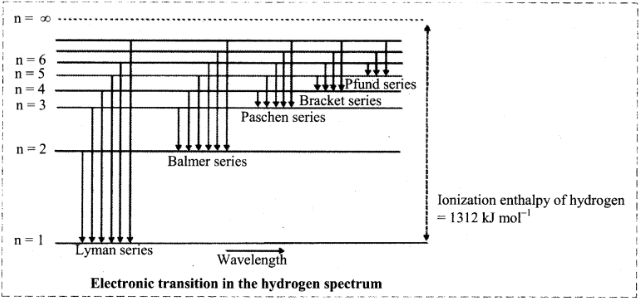
Observe the following diagram showing electronic transition in the hydrogen spectrum.

Image

i. Electron jumps from higher energy level to n = 1. Which series does it correspond to?
ii. Electron jumps from higher energy level to n = 4. Which series does it correspond to?
iii. Which transition will give second line of Balmer series?
Comment on the extent to which the forward reaction will proceed, from the magnitude of the equilibrium constant for the following reactions:
$i. H_{2(g)} + I_{2(g)} ⇌ 2HI_{(g)}, K_c = 20 at 550 K$
$ii. H_{2(g)} + Cl_{2(g)} ⇌ 2HCl_{(g)}, K_c = 1018 at 550 K$
What is the stationary phase in Paper Chromatography?
Consider the following molecules and answer the questions:
$CH_3 – CH_2 – CH_2 – Cl, CH_3 – CH_2 – CH_2 – Br, CH_3 – CH_2 – CH_2 – I.$
$i.$ What type of inductive effect is expected to operate in these molecules?
$ii.$ Identify the molecules from these three, having the strongest and the weakest inductive effect.
Write resonance structures of $H – COO^–$ and comment on their relative stability.
If $n = 2,$ what are the values of quantum number $l$ and $m_l$ ?
 A syringe has a volume of $10.0 cm^3$ at pressure $1$ atm . If you plug the end so that no gas can escape and push the plunger down, what must be the final volume to change the pressure to $3.5$ atm?
Image