Question
How are sol, solution and suspension different from each other?

Answer

Property Sol Solution Suspension
Nature Heterogenous Homogenous Heterogenous
Particle size $10^{-7}-10^{-5}$cm Less than $1$nm More than $100$nm
Stability Quite stable Very stable Unstable
Tyndall effect yes no yes/no
Appearance Generally clear clear opaque
visibility Visible with an ultra microscope Not visible Visible with naked eye
Diffusion Diffuses very slowly Diffuses rapidly Do not diffuse
Settling Get settled in centrifugation Do not settle Settle on their own
Example Milk, blood, smoke Salt and sugar in water Sand in water, dusty air

Need a full question paper?

Generate a complete, print-ready paper with questions like this in minutes — across 16+ boards, with answer keys.
Start Generating Free

Similar questions

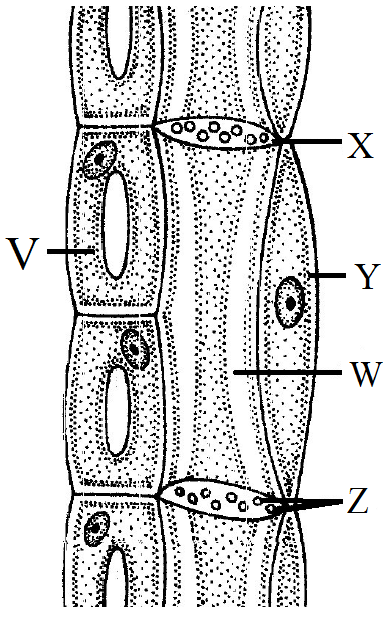
  1. Identify the figure. What is its function$?$
  2. Label $V$ and $W.$
  3. Label $X, Y$ and $Z.$
  4. W loses its nucleus in the mature state, still it remains alive. Explain how$?$
Write an activity to show that water can be made to boil even at a temperate below its normal boiling point $(100^\circ\ C)$.
Describe an experiment to show that sound cannot pass through vacuum.
Write down four main characters of gymno-sperms.
Distinguish between Nonchordata and Chordata.
Distinguish between longitudinal and transverse waves.
A car is travelling along the road at 8ms-1. It accelerates at 1ms-2 for a distance of 18m. How fast is it then travelling?
The electronic configuration of an element $Z$ is $2, 8, 8.$
  1. What is the atomic number of the element$?$
  2. State whether element $Z$ is a metal or a non-metal.
  3. What type of ion (if any) will be formed by an atom of element $Z?$ Why$?$
  4. What is special about the outermost electron shell or the atom of this element$?$
  5. Give the name and symbol of element $Z.$
  6. Name the group of elements to which $Z$ belongs.
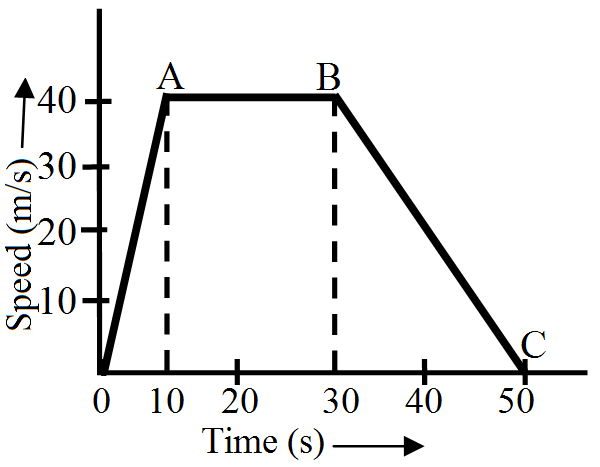
Study the speed-time graph of a car given alongside and answer the following questions:


  1. What type of motion is represented by OA?
  2. What type of motion is represented by AB?
  3. What type of motion is represented by BC?
  4. What is the acceleration of car from O to A?
  5. What is the acceleration of car from A to B?
  6. What is the retardation of car from B to C?
How are the criteria for deciding divisions in plants different from the criteria for deciding the subgroups among animals?