Question
How are water and minerals transported in plants?

Answer

Water conducting channels: Xylem consists of vessels and tracheids, which form continuous water conducting channel.
Absorption of water by the roots: The root cells actively take up ions from soil. This creates a difference in the concentration of these ions between the root and the soil. Water, therefore moves into the root from the soil to eliminate this difference.
Column of water: To eliminate the concentration difference between the soil and the root, the steady movement of water into root creates column of water.
Conduction of water by root pressure: Due to absorption of water by root cells, a pressure is generated to push water in xylem element.
This pressure is insufficient  to move water over the heights of plants. So, plants use another strategy to move water in xylem upwards to the highest points of the plant body.
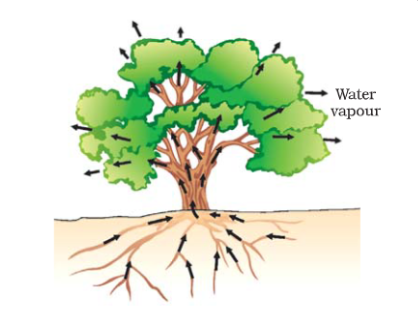
Conduction of water by transpiration pull: The loss of water in the form of vapour from the aerial parts of the plant is known as transpiration.
The water which is lost through the stomata is replaced by water from the xylem vessels in the leaf. Evaporation of water molecules from the cells of a leaf creates a sunction which pulls water from the xylem cells of roots.
During the day when the stomata are open, the transpiration pull becomes the major driving force in the movement of water in the xylem.
At night effect of root pressure is necessary for the upward flow of water.
Thus, transpiration helps in absorption and upward movement of water and minerals dissolved in it from roots to the leaves.
Image

Need a full question paper?

Generate a complete, print-ready paper with questions like this in minutes — across 16+ boards, with answer keys.
Start Generating Free