MCQ
How are we able to see both the nearby and the distant objects clearly:
  • A
    By changing the focal length of the eye lens.
  • B
    By changing the size of the eye lens.
  • C
    By changing the power of the eye lens.
  • D
    None of these.

Answer

  1. By changing the focal length of the eye lens.

Explanation:

Human eye is able to see nearby and distant objects clearly by changing the focal length of the eye lens, This availability of eyes is called power of accommodation.

Need a full question paper?

Generate a complete, print-ready paper with questions like this in minutes — across 16+ boards, with answer keys.
Start Generating Free

Similar questions

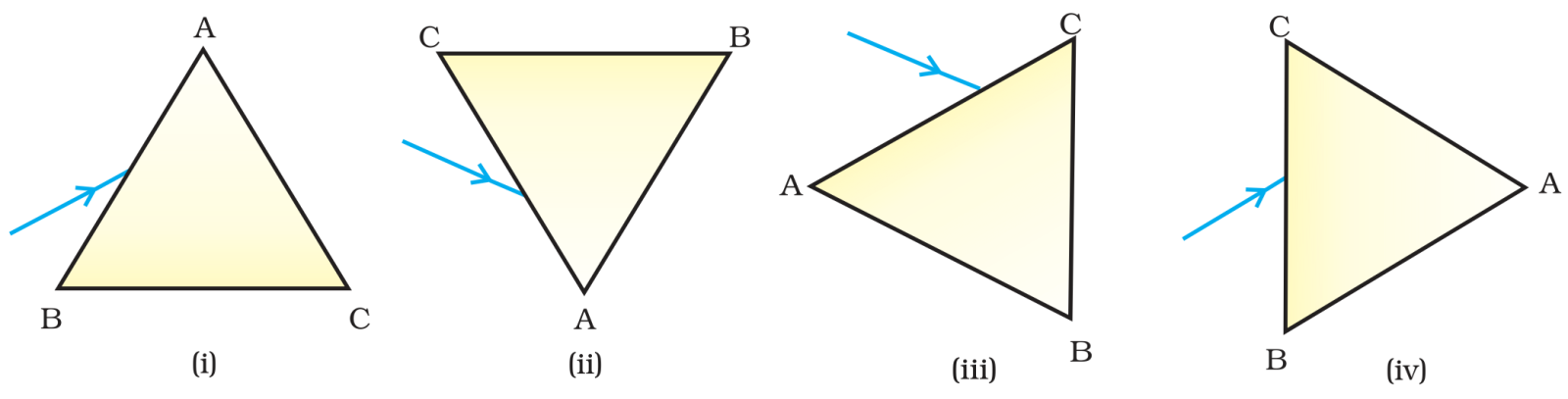
A prism ABC (with BC as base) is placed in different orientations. A narrow beam of white light is incident on the prism as shown in Figure. In which of the following cases, after dispersion, the third colour from the top corresponds to the colour of the sky?

  1. (i)
  2. (ii)
  3. (iii)
  4. (iv)
A beam of white light falls on a glass prism. The colour of light which undergoes the least bending on passing through the glass prism is:
  1. Violet.
  2. Red.
  3. Green.
  4. Blue.
How much energy does a 100W electric bulb transfer in 1 minute?
  1. 100J.
  2. 600J.
  3. 3600J.
  4. 6000J.
Production of electricity from magnetism is called:
When a 1 ohm resistor is connected across the potential difference of 20V, what will be power dissipation in it:
Magnification produced by a plane mirror is:
  1. Less than one.
  2. Greater than one.
  3. Zero.
  4. Equal to one.
The coloured light having the maximum speed in glass prism is:
  1. Blue.
  2. Green.
  3. Violet.
  4. Yellow.
Which statement/statement is/ are correct?
  1. An ammeter is connected in series in a circuit and a voltmeter is connected in parallel.
  2. An ammeter has a high resistance.
  3. A voltmeter has a low resistance.
n normal use, a current of 3.5A flows through a hair dryer. Choose a suitable fuse from the following:
  1. 3A
  2. 5A
  3. 10A
  4. 30A