Question
How are we able to see nearby and also the distant objects clearly?

Answer

Human eyes have power of accommodation. When we have to see distant objects, the eye muscles relax and lens becomes thin. Due to this, the focal length of the lens increases and the eye is able to see distant objects. When we have to see nearby objects, the eye muscles contract and lens becomes thick. Due to this, the focal length of the lens decreases and the eye is able to see nearby objects.
Need a full question paper?

Generate a complete, print-ready paper with questions like this in minutes — across 16+ boards, with answer keys.

Start Generating Free

Similar questions

Describe with the help of a ray diagram the nature, size and position of the image formed when an object is placed in front of a convex lens between focus and optical centre. State three characteristics of the image formed.
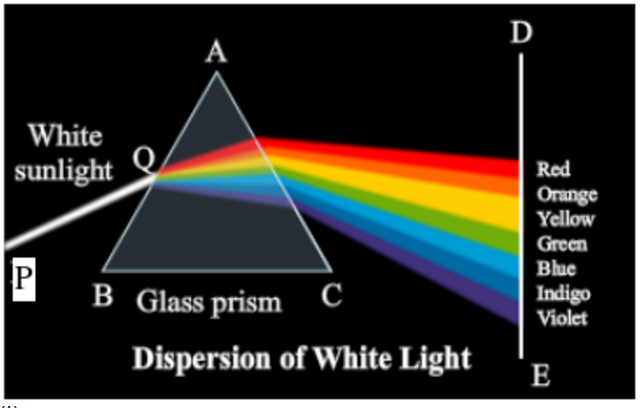
A narrow beam PQ of white light is passing through a glass prism ABC as shown in the diagram.

Trace it on your answer sheet and show the path of the emergent beam as observed on the screen DE.
  1. Write the name and cause of the phenomenon observed.
  2. Where else in nature is this phenomenon observed?
  3. Based on this observation, state the conclusion which can be drawn about the constituents of white light.
In an experiment to study the scattering of light by passing a beam of white light through a colloidal solution of sulphur in a transparent glass tank:
  1. Which colour is observed from the front of the glass tank? Does this colour correspond to the colour of sky on a clear day or the colour of sky around the sun at sunset?
  2. Which colour is observed from the sides of the glass tank? Does this colour correspond to the colour of sky on a clear day or the colour of sky around the sun at sunset?
A concave lens has a focal length of 20cm. At what distance from the lens a 5cm tall object be placed so that it forms an image at 15cm from the lens? Also calculate the size of the image formed.
What is ‘‘dispersion of white light’’? Draw a labelled diagram to illustrate the recombination of the spectrum of white light. Why is it essential that the two prisms used for the purpose should be identical and placed in an inverted position with respect to each other?
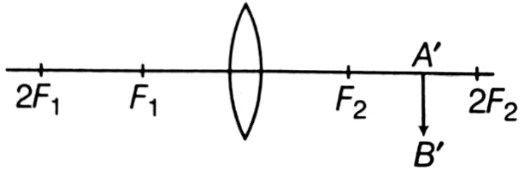
Observe the following incomplete ray diagram of an object where the image A'B' is formed after refraction from a convex lens.
Image
On the basic of above information fill in the blanks.
i. The position of object AB would have been...
ii. Size of the object would have been ... than the size of image.
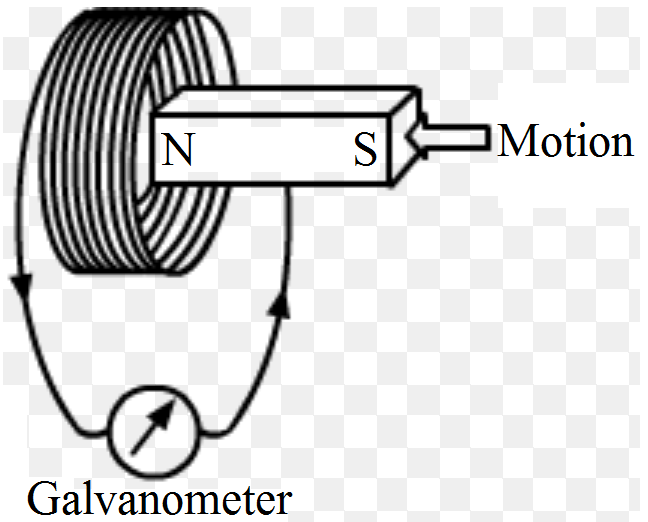
When the magnet shown in the diagram below is moving towards the coil, the galvanometer gives a reading to the right.

  1. What is the name of the effect being produced by the moving magnet?
  2. State what happens to the reading shown on the galvanometer when the magnet is moving away from the coil.
  3. The original experiment is repeated. This time the magnet is moved towards the coil at a great speed. State two changes you would notice in the reading on the galvanometer.
A p.d. of 10V is needed to make a current of 0.02A flow through a wire. What p.d. is needed to make a current of 250mA flow through the same wire?
For the same angle of incidence, the angle of refraction in three different media A, B and C are 10°, 25° and 40°, respectively. In which medium the velocity of light will be maximum?
A diverging mirror of radius of curvature 40cm forms an image which is half the height of the object. Find the object and image positions.