Question
How are winds produced?

Answer

The movement of air from one region to another creates winds. When the solar radiations fall on the earth, some are absorbed and majority of these are reflected back by the land and water bodies. These reflected solar radiations heat up the atmosphere from below. As a result convection currents are set up in the air but since land gets heated faster than the water, the air above the land gets heated faster than the air over water bodies. During the day the air above the land gets heated and starts rising, creating a region of low pressure below. As a result the air over the sea moves into this region of low pressure and forms the wind.
Need a full question paper?

Generate a complete, print-ready paper with questions like this in minutes — across 16+ boards, with answer keys.

Start Generating Free

Similar questions

Three different vibrating objects produce three types of sounds $X, Y$ and $Z.$ Sounds $X$ and $Y$ cannot be heard by a man having normal range of hearing but sound $Z$ can be heard easily. The sound $X$ is used in hospitals to break kidney stones of a patient into fine grains whioch then get flushed out with urine. The sound $Y$ is similar to that which is produced during an earthquake before the main shock wave is generated.
  1. What type of sounds are $(i) X, (ii) Y,$ and $(iii) Z?$
  2. Name one device which can produce sound like $X.$
  3. Name one device in a science laboratory which can produce sound like $Y.$
  4. Name one device in our homes which can produce sound like $Z.$
  5. What is the frequency range of sounds like $Z?$
Discuss why pesticides are used in very accurate concentration and in very appropriate manner$?$
Explain the various methods of crop improvement. Name one improved variety of Rice, Maize, Soybean, Sunflower and Mustard.
Classify connective tissue and give one example of each type.
When a beam of sunlight enters a room through a window, we can see tiny particles $X$ suspended in a gas $($or rather a mixture of gases$) Y$ which are moving rapidly in a very haphazard manner.
  1. What could particles $X$ be$?$
  2. Name the gas $($or mixture of gases$) Y.$
  3. What is the phenomenon exhibited by particles $X$ known as$?$
  4. What is causing the movement of particles $X?$
  5. What conclusion does the existence of this phenomenon give us about the nature of matter$?$
i. Draw a neat and labelled diagram of the apparatus used to separate components of blue-black ink. Name the process and state the principle involved.
ii. Identify, the physical and chemical changes from the following.
a. Burning of magnesium in air.
b. Tarnishing of silver spoon.
c. Sublimation of iodine.
d. Electrolysis of water.
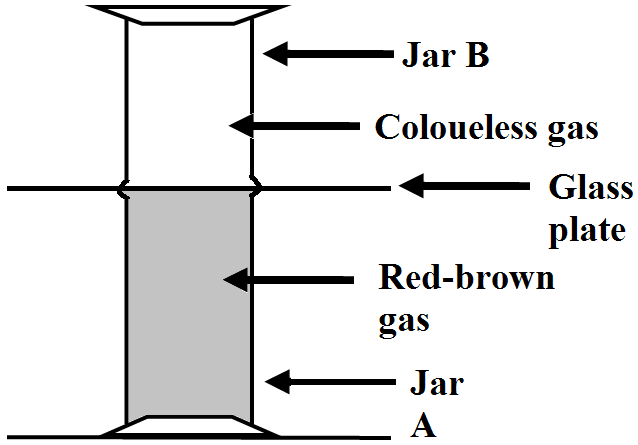
Look at the diagram on the right side. Jar $A$ contains are d-brown gas whereas Jar $B$ contains a colourless gas. The two gas jars are separated by a glass plate placed between them:
  1. What will happen when the glass plate between the two jars is pulled away?
  2. What name is given to the phenomenon which takes place?
  3. Name the brown gas which could be in jar $A$.
  4. Which is the colorless gas most likely to be present in jar $B$?
  5. Name one coloured solid and one colourless liquid which can show the same phenomenon.
$A, B$ and $C$ are all liquids. Liquid $A$ has a comparatively low boiling point. On heating, liquid a vaporizes completely without leaving behind any residue. Liquid $A$ is being used increasingly as a fuel in motor vehicles either alone or by mixing with petrol. Liquid $B$ has a very high boiling point. It also vaporizes completely on heating, without leaving any residue. Liquid $B$ is a conductor of electricity and used in making thermometers. Liquid $c$ has a moderate boiling point. On heating, liquid $C$ vaporises leaving behind a white solid $D$ which is used in cooking vegetables. The condensation of vapours from $C$ give a liquid $E$ which turns anhydrous $\mathrm{CuSO}_4$ to blue.
  1. Which liquid could be an element? Name this element.
  2. Which liquid could be a mixture? Name this mixture.
  3. Which liquid could be a compound? Name this compound.
  4. What could the solid $D$ be?
  5. What do you think is liquid $E$?
Write an essay on crop protection management.
Explain the various preventive measures against insect pests.