Question
How camouflage helps in adaptation?

Answer

Camouflage is the built-in protection in the animals which increase their chances of survival by tricking predators. Many tropical animals have sensitive hearing, sharp eyesight, thick skin and a skin colour which helps them to camouflage by blending with the surroundings. This helps them to protect themselves from predators. Example, big cats like lions and tigers have thick skin and sensitive hearing.

Need a full question paper?

Generate a complete, print-ready paper with questions like this in minutes — across 16+ boards, with answer keys.

Start Generating Free

Similar questions

How does chewing food properly help in digestion?
How does plant respire?
On last Monday, Pankaj was dealing with immense cough and cold. Besides this, he was suffering from a headache. So, he decided to take a leave on that day so that he could take some rest at his home. After one hour he thought to check his fever through a clinical thermometer, so before using it, he washed it and started shaking it very fastly in his hand, so that the mercury level of thermometer gets reduced. At the same time, his elder brother Vishwas scold him and suggested him to shake the thermometer slowly.
(i) State some precautionary measures while checking the fever through a clinical thermometer.
(ii) Mention the values showed by the elder brother of Pankaj (i.e. Vishwas).
Jaya returned from school and found that her grandmother was scolding their maid Rani, as she did not come the day before. The maid told that her son was passing watery stools frequently that's why she did not come. Jaya's mother who was listening the discussion came to them and told Rani not to come for coming 3-4 days. She also suggested to give her son a solution of sugar and salt in (boiled and cooled) water, many times a day for fast recovery. Jaya was surprised. She rushed to her mother and asked the scientific reason for it. Her mother smiled and explained her the importance of this solution.
(i) Name the term used to describe the condition in which a person passes out watery stools.
(ii) Name the solution of sugar and salt in water. Why is it given to a person suffering from this condition?
Read the passage and answer the questions :
Tanya connects an LED across a battery but it does not glow. She changes the direction and it works.
Q.1. Why did not the LED glow the first time?
(a) Broken battery$\quad$(b) Reverse connection
(c) High voltage$\quad$(d) Weak wire
Q.2. What nature does this show about LED?
(a) Can glow either way$\quad$(b) Needs heat
(c) Works only in one direction
(d) Emits heat
Q.3. Which wire is the positive terminal of the LED?
(a) Longer wire$\quad$(b) Shorter wire
(c) Any wire$\quad$(d) None of these
State one function of the following:
  1. Arteries.
  2. Vein.
  3. Capillaries.
Explain the digestive system of a human being with the help of a labelled diagram.
Make a table to show the donor blood group and recipient blood group.
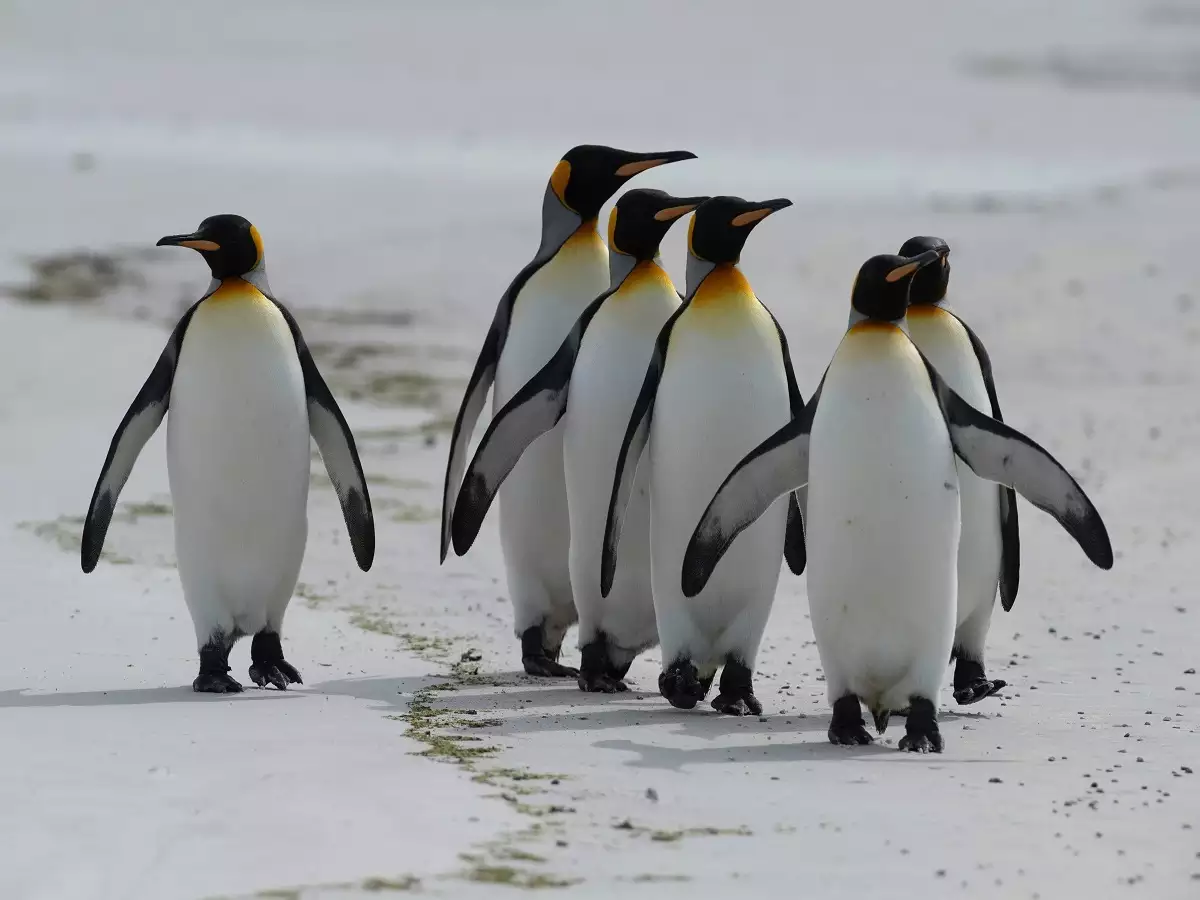
Observe the given figure and answer the following.
  1. Name the birds shown in figure.
  2. What are these birds doing and why?
  3. These birds live in which region?
Read the passage and answer the questions :
You are conducting an experiment where you add vinegar to baking soda. As soon as the two substances mix, there is a fizzing sound, and bubbles of gas begin to form, pass this gas through freshly prepared lime water. You observe that the lime water has turned milky due to formation of a precipitate.
Q.1. What type of change has occurred in this experiment?
(a) Physical change
(b) Chemical change
(c) Both physical and chemical change
(d) No change
Q.2. What is the gas that has been produced in this reaction?
(a) Oxygen$\quad$(b) Nitrogen
(c) Carbon dioxide$\quad$(d) Hydrogen
Q.3. What is the name of the white precipitate that forms in the solution?
(a) Calcium hydroxide
(b) Calcium carbonate
(c) Sodium bicarbonate
(d) Magnesium oxide