MCQ
How can an electrochemical cell be converted into an electrolytic cell?
  • Applying an external opposite potential greater than $\mathrm{E}_{\text {cell }}^0$
  • B
    Reversing the flow of ions in salt bridge.
  • C
    Applying an external opposite potential lower than $\mathrm{E}_{\text {cell }}^0$.
  • D
    Exchanging the electrodes at anode and cathode.
Answer

Correct option: A.
Applying an external opposite potential greater than $\mathrm{E}_{\text {cell }}^0$
a
Applied external potential should be greater than $\mathrm{E}_{\text {cell }}^0$ in opposite direction.

Need a full question paper?

Generate a complete, print-ready paper with questions like this in minutes — across 16+ boards, with answer keys.

Start Generating Free

Similar questions

Below are two statements, one labeled as Assertion $(A)$ and the other as Reason $(R):$

Assertion $(A)$: Among group $13$ elements, boron's melting point is unusually high $(2453 \mathrm{~K})$.

Reason $(R):$ Solid boron has a strong crystalline lattice.

In the context of the above statements, choose the correct answer from the following options:

For the equilibrium $2N{O_2}_{(g)}$ $\rightleftharpoons$ ${N_2}{O_4}_{(g)}$ $ + 14.6\,kcal$ the increase in temperature would
The electromotive force for the cell is $C{u_{\left( s \right)}}|Cu_{\left( {0.004\,M} \right)}^{ + 2}||Cu_{\left( {0.1\,M} \right)}^{ + 2}|C{u_{\left( s \right)}}$
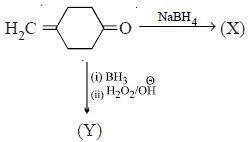
In the given reaction $(X)$ and $(Y)$ are :
What volume of $O_2(g)$ measured at $1\, atm$ and $273\, K$ will be formed by action of $100\, ml$ of $0.5\, N\, KMnO_4$ on hydrogen peroxide in an acid solution? The skeleton equation for the reaction is ............... $\mathrm{litre}$

$KMn{O_4} + {H_2}S{O_4} + {H_2}{O_4} \to {K_2}S{O_4} + MnS{O_4} + {O_2} + {H_2}O$

The results given in the below table were obtained during kinetic studies of the following reaction:

$2 A + B \longrightarrow C + D$

Experiment $[ A ] / molL ^{-1}$ $[ B ] / molL ^{-1}$ Initial $rate/molL$ $^{-1}$ $\min ^{-1}$
$I$ $0.1$ $0.1$ $6.00 \times 10^{-3}$
$II$ $0.1$ $0.2$ $2.40 \times 10^{-2}$
$III$ $0.2$ $0.1$ $1.20 \times 10^{-2}$
$IV$ $X$ $0.2$ $7.20 \times 10^{-2}$
$V$ $0.3$ $Y$ $2.88 \times 10^{-1}$

$X$ and $Y$ in the given table are respectively :


Which of the following compound shows geometrical isomerism
A sample of a hydrate of barium chloride weighing $61\,g$ was heated until all the water of hydration is removed. The dried sample weight is $52\,g.$ The formula of the hydrated salt is : ( atomic mass, $Ba = 137\,amu,\,\,Cl = 35.5\,amu$ )
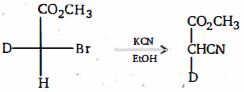
The configurations of the reactant and the product in the following reaction,  respectively, are:
The electronic configurations of $Eu$ (Atomic No. $63$), $Gd$ (Atomic No. $64$) and $Tb$ (Atomic No. $65$) are