Question
How can money easily exchange it for goods or services? Give example to explain.

Answer

Money acts easier to exchange for goods and services:
A person holding money can easily exchange it for any commodity or service that he or she might want.
Everyone prefers to receive payments in money and exchange the money for things they want.
Example: A shoemaker wants to sell shoes in the market and buy wheat. The shoemaker will first exchange shoes for money and then exchange the money for wheat. If the shoemaker had to directly exchange shoes for wheat without the use of money. He would have to look for a wheat growing farmer who not only wants to sell wheat but also wants to buy the shoe in exchange. Both the parties have to agree to sell and buy each other's commodities. This process is very difficult, time-consuming and unhealthy.

Need a full question paper?

Generate a complete, print-ready paper with questions like this in minutes — across 16+ boards, with answer keys.

Start Generating Free

Similar questions

Which law acts as a watchdog of democracy?
State any five achievements of the consumer movements in India.
Why did Imperial state of China get books printed?
What is the role of the opposition party in a democracy?
How does caste get politicised?
Read the source given below and answer the questions that follows. Source: The Movement in the Towns. The movement started with middle-class participation in the cities. Thousands of students left government-controlled schools and colleges, headmasters and teachers resigned, and lawyers gave up their legal practices. The council elections were boycotted in most provinces except Madras, where the Justice Party, the party of the non-Brahmans, felt that entering the council was one way of gaining some power–something that usually only Brahmans had access to. The effects of non-cooperation on the economic front were more dramatic. Foreign goods were boycotted, liquor shops picketed, and foreign cloth burnt in huge bonfires. The import of foreign cloth halved between 1921 and 1922, its value dropping from Rs. 102 crore to Rs. 57 crore. In many places merchants and traders refused to trade in foreign goods or finance foreign trade. As the boycott movement spread, and people began discarding imported clothes and wearing only Indian ones, production of Indian textile mills and handlooms went up.Questions:
  1. Explain the role of 'Justice Party' in boycotting of council elections.
  2. How was the effects of 'non-cooperation on the economic front' dramatic?
  3. Explain the effect of ‘Boycott’ movement on 'foreign textile trade'.
Differentiate between Nepal’s movement and Bolivia’s popular struggle.
What was Agenda 21 of Earth Summit of Rio de Janeiro?
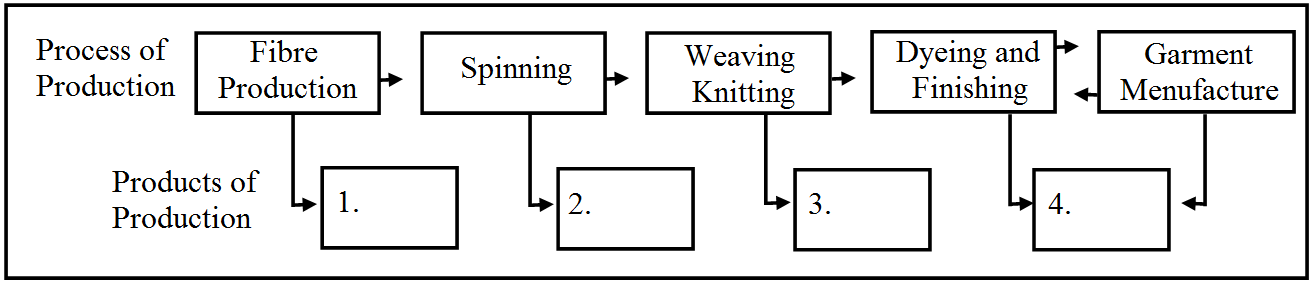
Look at the following chart that shows the processes of production. Fill in the products derived through the various processes of production in the boxes given below:
“Consumer awareness is essential to avoid exploitation in the market place.” Support the statement.