Question
How can phenol be converted to aspirin?
Answer

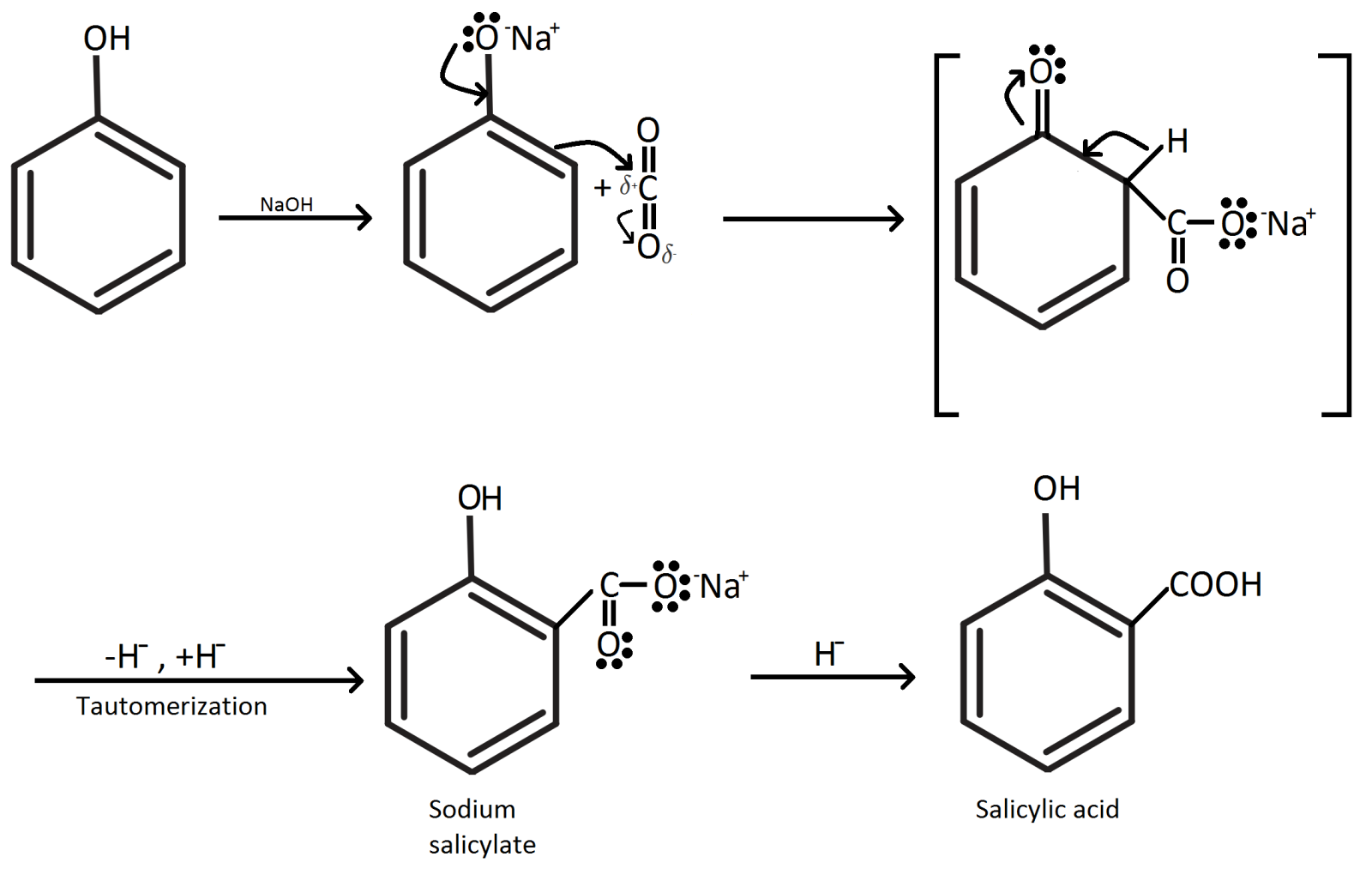
Phenol is converted into salicylic acid.
The reaction is usually carried out by allowing sodium phenoxide to absorb carbon dioxide and then heating the product to $400K$ and $4-7$ atm pressure. First unstable intermediate is formed which undergoes a proton shift to form sodium salicylate. The subsequent acidification of sodium salicylate gives,

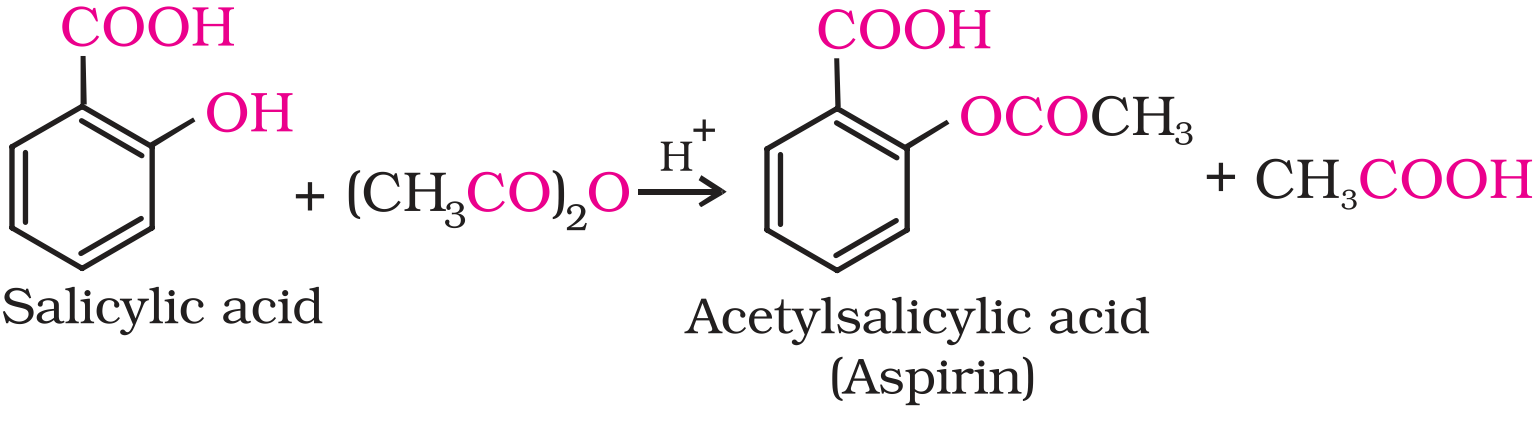
Then aspirin is obtained by acetylating salicylic acid with acetic anhydride and cons. $H_2SO_4.$

Need a full question paper?

Generate a complete, print-ready paper with questions like this in minutes — across 16+ boards, with answer keys.

Start Generating Free

Similar questions

Write the equation of trimerization and tetramerization of acetaldehyde.
When fresh grapes are kept in concentrated salt solution they shrink, whereas when they are kept back in water they swell up. Why?
a. A soda bottle will go flat (loose its fizz) faster in Srinagar than in Delhi. Is this statement correct? Why or why not?
b. How does sugar help in increasing the shelf life of the product?
Image
In the above reaction sequence, write the chemical formula and IUPAC name of X and Y.
Write the main structural difference between DNA and RNA. Of the four bases, name those which are common to both DNA and RNA.
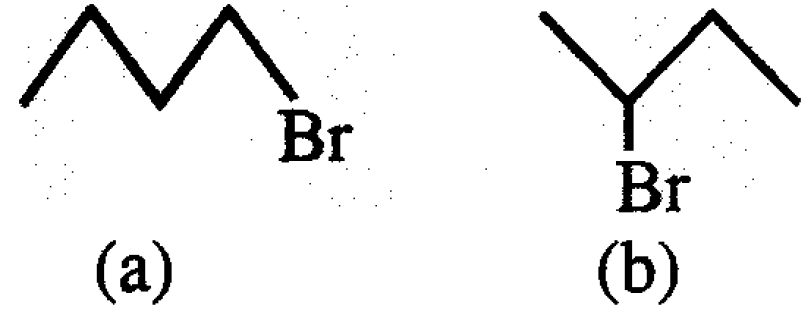
  1. Which alkyl halide from the following pair is chiral and undergoes faster $\ce{S_N2}$ reaction?
  1. Out of $\ce{S_N1}$ and $\ce{S_N2},$ which reaction occurs with
  1. Inversion of configuration.
  2. Racemisation.
What are reduction potential and oxidation potential?
What are anomers? Give one example.
Two half cell reactions of an electrochemical cell are given below$:$
$\ce{MnO_4^- (aq) + 8H^+ (aq) + 5e^– \rightarrow Mn^{2+ }(aq) + 4H_2O (l), E^o = + 1.51 V}$
$\ce{Sn^{2+} (aq) \rightarrow Sn^{4+} (aq) + 2e^–, E^o = + 0.15 V}$
Construct the redox equation from the two half cell reactions and predict if this reaction favours formation of reactants or product shown in the equation.
Following data are obtained for the reaction:
$N_2O_5 \rightarrow 2NO_2 + ½O_2$
$t/s$ $0$ $300$ $600$
$[N2O5]/mol L^{–1}$ $1.6 \times 10^{–2}$ $0.8 \times 10^{–2}$ $0.4 \times 10^{–2}$
  1. Show that it follows first order reaction.
  2. Calculate the half$-$life.
$($Given $\log 2 = 0.3010 \log 4 = 0.6021)$