Question
How can reverberations in a big hall or auditotium be reduced?`

Answer

Reverberations in a big hall or auditorium can be reduced by the following methods:
  1. Panels made of sound absorbing materials are put on the walls and ceilings of hall and auditorium.
  2. Carpets are put on the floor to absorb sound and reduce reverberations.
  3. Heavy curtains are put on doors and windows to absorb sound and reduce reverberations.
  4. The seats in the hall are made from materials having sound absorbing properties.

Need a full question paper?

Generate a complete, print-ready paper with questions like this in minutes — across 16+ boards, with answer keys.
Start Generating Free

Similar questions

Describe the composition and functions of blood
Write a short note on prevention of animal diseases.
Name the process associated with the following:
i. Dry ice is kept at room temperature and at one atmospheric pressure.
ii. A drop of ink placed on the surface of water contained in a glass spreads throughout the water.
iii. A potassium permanganate crystal is in a beaker and water is poured into the beaker with stirring.
iv. A acetone bottle is left open and the bottle becomes empty.
v. Milk is churned to separate cream from it.
vi. Settling of sand when a mixture of sand and water is left undisturbed for some time.
vii. Fine beam of light entering through a small hole in a dark room, illuminates the particles in its paths.
What is feed? What are different type of feed? How is it differ with respect to age and functions?
State the law of conservation of mass. Give one example to illustrate this law.
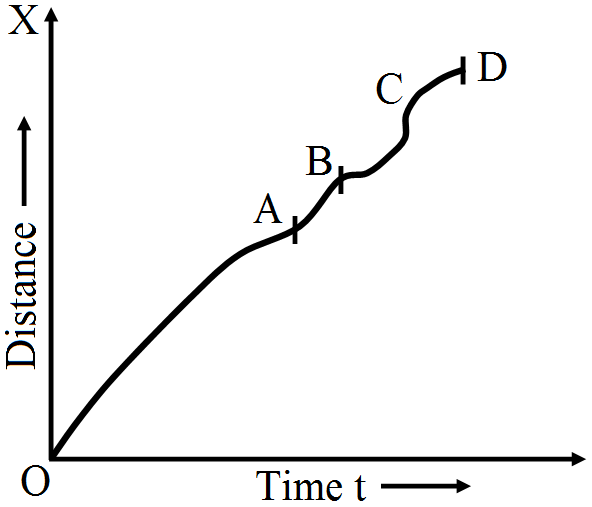
The figure shows an $x-t$ graph of a particle moving along a straight line. What is the sign of the acceleration during the intervals $OA, AB, BC,$ and $CD?$
What principles should be taken in account for the prevention of diseases?
Discuss the method of separating a mixture containing chalk powder, iron fillings and naphthalene.
A body of $2kg$ falls from rest. What will be its kinetic energy during the fall at the end of $2s? ($Assume $g = 10m/s^2)$
Three different vibrating objects produce three types of sounds $X, Y$ and $Z.$ Sounds $X$ and $Y$ cannot be heard by a man having normal range of hearing but sound $Z$ can be heard easily. The sound $X$ is used in hospitals to break kidney stones of a patient into fine grains whioch then get flushed out with urine. The sound $Y$ is similar to that which is produced during an earthquake before the main shock wave is generated.
  1. What type of sounds are $(i) X, (ii) Y,$ and $(iii) Z?$
  2. Name one device which can produce sound like $X.$
  3. Name one device in a science laboratory which can produce sound like $Y.$
  4. Name one device in our homes which can produce sound like $Z.$
  5. What is the frequency range of sounds like $Z?$