Question
How can you find the following?
1. Velocity from a displacement - time graph.
2. Acceleration from velocity - time graph.
3. Displacement from velocity - time graph.
4. Velocity from acceleration - time graph.
Answer

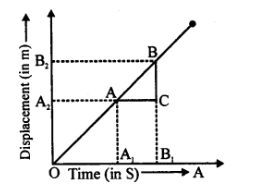
(i) Velocity from a displacement - time graph : Displacement time graph for uniform motion is a straight line (OP) inclined to time axis. Take any two points $A$ and $B$ on this graph OP. From $A$ and $B$, draw perpendiculars on time axis as well as displacement axis. So, by knowing the slope of displacement - time graph. We can find the velocity of the body.
Image
Such that,
$OA_1=t_1, OB_1=t_2, OA_2=x_1 \text { and } OB_2=x_2$
Slope of displacement - time graph $=\frac{ BC }{ AC }$
$=\frac{x_2-x_1}{t_2-t_1}=\frac{\Delta x}{\Delta t}=$ Velocity of the body.
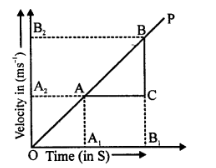
(ii) Acceleration from velocity –time graph : Velocity –time graph for uniform motion is a straight line (OP) inclined to time axis.
Image
Take any two points A and B on this graph. From A and B draw perpendicular on time axis as well as velocity axis in such a way that
$
OA_1=t_1, OB_1=t_2, OA_2=v_1 \text { and } OB_2=v_2$
Slope of $v-t$ graph $=\frac{B C}{A C}$
$=\frac{v_2-v_1}{t_2-t_1}=\frac{\Delta v}{\Delta t}$
$=$ Acceleration of the body
So, by knowing the slope of velocity -time graph for uniform motion, we can find the acceleration of the body.
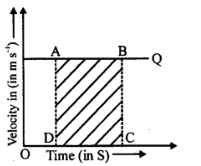
(iii) Displacement from velocity-time graph: Displacement covered by a body is equal to the area under velocity - time graph. When object moves with a uniform velocity, then velocity - time graph is a straight line (PQ) parallel to time axis.
Image
Take any two points $A$ and $B$ on velocity time graph.
From A and B , draw two perpendiculars AD and BC on time axis such that
$
OD=t_1 \text { and } OC=t_2
$
Let $OP = AD = BC =v=$ Velocity of the body.
Area under velocity - time graph = Area of rectangle ABCD .
$= AD \times DC =v \times( OC - OD )=v\left(t_2-t_1\right)$
$=$ Displacement covered by the body.
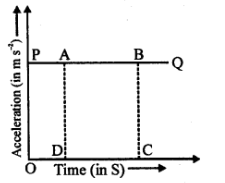
(iv) Velocity from acceleration - time graph : Area under the acceleration - time graph gives the velocity of the body. When the body moves with variable velocity but uniform acceleration, then acceleration - time graph is a straight line $(P Q)$ parallel to time axis.
Image
Take any two points A and B on PQ. From P and Q, draw perpendiculars ( $B C$ and $A D$ ) on time axis. Such that,
$
OD=t_1 \text { and } OC=t_2
$
Let $OP = AD = BC =a=$ acceleration of the body.
Area under acceleration - time graph = area of rectangle
ABCD .
$
\begin{array}{l}
=AD \times DC=AD \times(OC-OD) \\
=a\left(t_2-t_1\right) \\
=\frac{v-u}{\left(t_2-t_1\right)}\left(t_2-t_1\right)=v-u
\end{array}
$
If initial velocity of the body $= u =0$ Then area under acceleration - time graph $= v -0=$ $v=$ velocity of the body.

Need a full question paper?

Generate a complete, print-ready paper with questions like this in minutes — across 16+ boards, with answer keys.

Start Generating Free

Similar questions

The following table gives the displacement of a car at different instants of time.
Time (s) 0 1 2 3 4
Displacement (m) 0 5 10 15 20
(a) Draw the displacement-time sketch and find the average velocity of the car. (b) What will be the displacement of the car at (i) 2.5 s and (ii) 4.5 s?
A rubber ball floats in water with $2 / 7$ of its volume above the surface of water. Calculate the average relative density of rubber ball.
A micrometre screw gauge has a negative zero error of 7 divisions. While measuring the diameter of a wire the reading on main scale is 2 divisions and 79th circular scale division coincides with base line.
If the number of divisions on main scale is 10 to a centimetre and circular scale has 100 divisions, calculate
1. pitch
2. observed diameter
3. least count
4. corrected diameter.
State the laws of liquid pressure.
How does a graph help in determining the proportional relationship between two quantities?
What is the difference between a ray of light and a beam of light?
A block of wood of mass $24$ kg floats on water. The volume of wood is $0.032 m^3$. Find :(a) the volume of block below the surface of water,
(b) the density of wood.
(Density of water $=1000 kg m ^{-3}$ )
A hollow metal cylinder of length 10 cm floats in alcohol of density $0.80 g cm ^{-3}$, with 1 cm of its length above it. What length of cylinder will be above copper sulphate solution of density $1.25 g cm ^{-3}$ ?
A 50 m long train passes over a bridge at a speed of 30 km/h. If it takes 36 seconds to cross the bridge, calculate the length of the bridge.
How does the presentation of data in a tabular form help us in analyzing them? Explain with one example.