Question
How can you help reduce air pollution at the individual level?

Answer

Pollution is not a distant phenomenon anymore. It is affecting the quality of our day to day lives. We must realize our responsibility and should start using the following environment$-$ friendly processes:
$-$We should switch to cleaner fuels like $\text{CNG}$$-$ Compressed natural gas and $\text{LPG}$ Liquified petroleum gas for both industries and automobiles.
$-$Automobiles should also use unleaded petrol.
$-$We should plant more trees which will help to control deforestation.
$-$Industrial waste should be treated for harmful chemicals before discharging into air the water bodies.
$-$We must switch to alternative fuels instead of fossil fuels. Alternative sources of energy can be solar energy, hydropower and wind energy.
$-$We must encourage the use a public transport, a bicycle or walking for short distances. This will help to reduce the use of fossil fuels.
$-$Burning of plant waste also causes pollution by the emission of smoke. Plant waste must be put in a compost rather than burning.
Need a full question paper?

Generate a complete, print-ready paper with questions like this in minutes — across 16+ boards, with answer keys.

Start Generating Free

Similar questions

Identify the actions involved in the following situations as push or pull, or both:
$a.$ Opening a drawer.
$b.$ A cricket ball hit by a batsman.
$c.$ Drawing a bucket of water from a well.
$d.$ moving a book placed on a table.
$e.$ A football player taking a penalty corner.
$f.$ Moving a wheel barrow.
The material $A$ is a fossil fuel which is extracted from the earth. It is said to be formed from the buried, large land plants by a very slow process $B$. When $A$ is heated in the absence of air in a process called $C$, then it gives three products $D, E$ and $F$. The product $D$ is used as a reducing agent in the extraction of metals, the product $E$ is used as an industrial fuel whereas the product $F$ has been traditionally used for metalling the roads.
$a.$ What could material $A$ be?
$b.$ What is $(i)$ physical state, and $(ii)$ colour, of $A?$
$c.$ Name the processes $(i) B,$ and $(ii) C.$
$d.$ What are $(i) D, (ii) E$, and $(iii) F?$

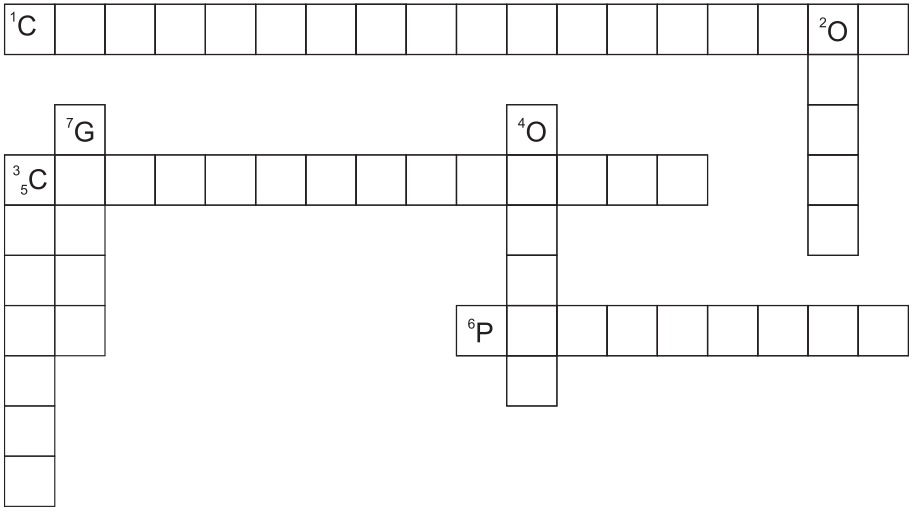
Complete the crossword puzzle with the help of clues given below:

Across
$1.$ Pollutant which was used in refrigerators and air conditioners. $(18)$
$3.$ Produced on incomplete combustion of fuels. $(14)$
$6.$ This chemical protects our crops and is washed into water bodies from the field. $(9)$
Down
$2.$ This layer protects us from harmful ultraviolet rays. $(5)$
$4.$ It is essential for combustion. $(6)$
$5.$ Disease which is caused by drinking contaminated water. $(7)$
$7.$ River which is famous in India and sustains most of the northern, central and eastern Indian population. $(5)$
What is a Wildlife Sanctuary? Name any two Wildlife sanctuaries in India. Where are these Sanctuaries located?
Write a short note on the unit in which astronomical distances are measured.
Explain why sliding friction is less than static friction.
Distinguish between metals and non-metals on the basis of their chemical properties.
Explain how fertilisers are different from manure .
Snehal dug two pits, A and B, in her garden. In pit A, she put fruit and vegetable peels and mixed them with dried leaves. In pit B, she dumped the same kind of waste without mixing it with dried leaves. She covered both the pits with soil and observed after 3 weeks. What is she trying to test?
Explain how, deforestation leads to frequent flooding of rivers.