Question
How can you prove that hydrochloric acid contain :
Chlorine?

Answer

On reaction with oxidizing agents, hydrochloric acid forms respective salts water and pungent smelling, greenish yellow chlorine gas.$\underset{\text { Manganses dioxide }}{ MnO _4}+4 HCl \longrightarrow \underset{\text { Manganese chloride }}{ MnCl _2( aq )}+2 H _2 O + Cl _2 \uparrow$

Need a full question paper?

Generate a complete, print-ready paper with questions like this in minutes — across 16+ boards, with answer keys.
Start Generating Free

Similar questions

Determine the empirical formula of a compound containing $47.9\% K, 5.5\%$ beryllium and $46.6\%$ fluorine by mass.
(a) Draw the structural formula for each of the following:
(i) Ethanoic acid (ii) But-2-yne
(b) Distinguish between the saturated hydrocarbon ethane and the unsaturated hydrocarbon ethene by drawing their structural formulae.
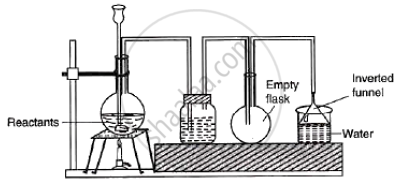
The given set up in the figure is for the preparation of an acid.

(a) Name the acid prepared by this method.
(b) name the reactants used.
(c) why empty flask is used
(d) what is the drying agent used? Why is this drying agent chosen?
(e) what is the role of the inverted funnel in the arrangement
State the reactions occurring at the anode during the electrolysis of :
(i) Copper sulphate solution, using copper electrodes.
(ii) Copper sulphate solution, using platinum electrodes.
(iii) Aluminium oxide, dissolved in cryolite using carbon electrodes.
How many salts can be obtained from ortho phosphoric acid? Is there any difference in the salts formed by the acid?
(a) Calculate the mass of ammonia that can be obtained from $21.4 g$ of $NH _4 Cl$ by the reaction:
$2 NH _4 Cl + Ca ( OH )_2 \rightarrow CaCl _2+2 H _2 O +2 NH _3$
(b) What will be the volume of ammonia when measured at S.T.P?
The molar volume of a gas $=22.4$ litres at STP.
Calculate the number of molecules in $12.8g$ of sulphur dioxide gas. Take Avogadro's number as $6 \times 10^{23}.$
$[S = 32, 0 = 16 ]$

Find the empirical formula of a compound containing 17.64 % hydrogen and 82.35 % of nitrogen.

(a) Fe + S → Fe2+S2-
Which substance in the above reaction is (i) oxidising agent (ii) reducing agent and why?
(b) 2Fe + 3Cl2 → 2Fe3+ + 2Cl3-
In the above reaction, which substance is (i) oxidised (ii) reduced, and why?
What happens when (Given balanced equation):
Nitric acid is added to Kl (aq)?