Question
How did the European countries resolve their post-Second World War problem? Briefly outline the attempts that led to the formation of the European Union.

Answer

As a result of Second World War, European countries comfronted the problems of ruin of their economies and the destruction of the assumptions and structures on which Europe had been founded. The burning question was whether the European countries be allowed to revert to its old rivalries or be reconstructed on the principles and institutions that would contribute to a positive conception of international relations. In those problems, Cold War played an important role in the integration of Europe.Thus, the following attempts led to the formation of the European Union in 1992:
  1. Marshall Plan: Under this plan, America extended massive financial help for reviving Europe’s economy.
  2. NATO: America created NATO as a new collective security structure.
  3. OEEC: Under Marshall Plan, the Organisation for European Economic Cooperation was established in 1948 to channel aid to the West European states. It encouraged cooperation on trade and economic issues.
  4. Council of Europe: It was established in 1949 for political cooperation.
  5. European Economic Community: It was formed in 1957.
  6. European Parliament: Economic integration took political dimension in the form of European Parliament.
  7. European Union: The disintegration of Soviet Union in 1991 led to formation of European Union in 1992. Its aim was to have a common foreign and security policy, cooperation on justice and home affairs and the creation of a single currency.

Need a full question paper?

Generate a complete, print-ready paper with questions like this in minutes — across 16+ boards, with answer keys.
Start Generating Free

Similar questions

What was the Soviet System? Assess any four features of the Soviet System.
Describe the two basic kinds of reforms on which almost everyone agrees that they must be introduced in the U.N. after the Cold War.
Trace the evolution of the United Nations since is establishment in 1945. How does it function with the help of its structures and agencies?
What were the main considerations for bringing princely states with Indian Union? Who played the historic role in this task?
During the early years of independence, despite the fact that the opposition parties had a token representation they played a crucial role in maintaining the democratic character of the system. How?
Analyse any three demerits of globalisation.
This new challenge came to the force in the 1980s, as the Janata experiment came to an end and there was some political stability at the centre. This decade will be remembered for some major conflicts and accords in the various regions of the country, especially in Assam, the Punjab, Mizoram and the developments in Jammu and Kashmir.
  1. Explain the meaning of the phrase 'Janta experiment came to an end.'
  2. 'There was some stability at the centre'. What does it imply?
  3. Highlight any two developments in Punjab in 1980s.
Suggest any three measures which, in your opinion, are very effective to strengthen the national integrity and unity of India.


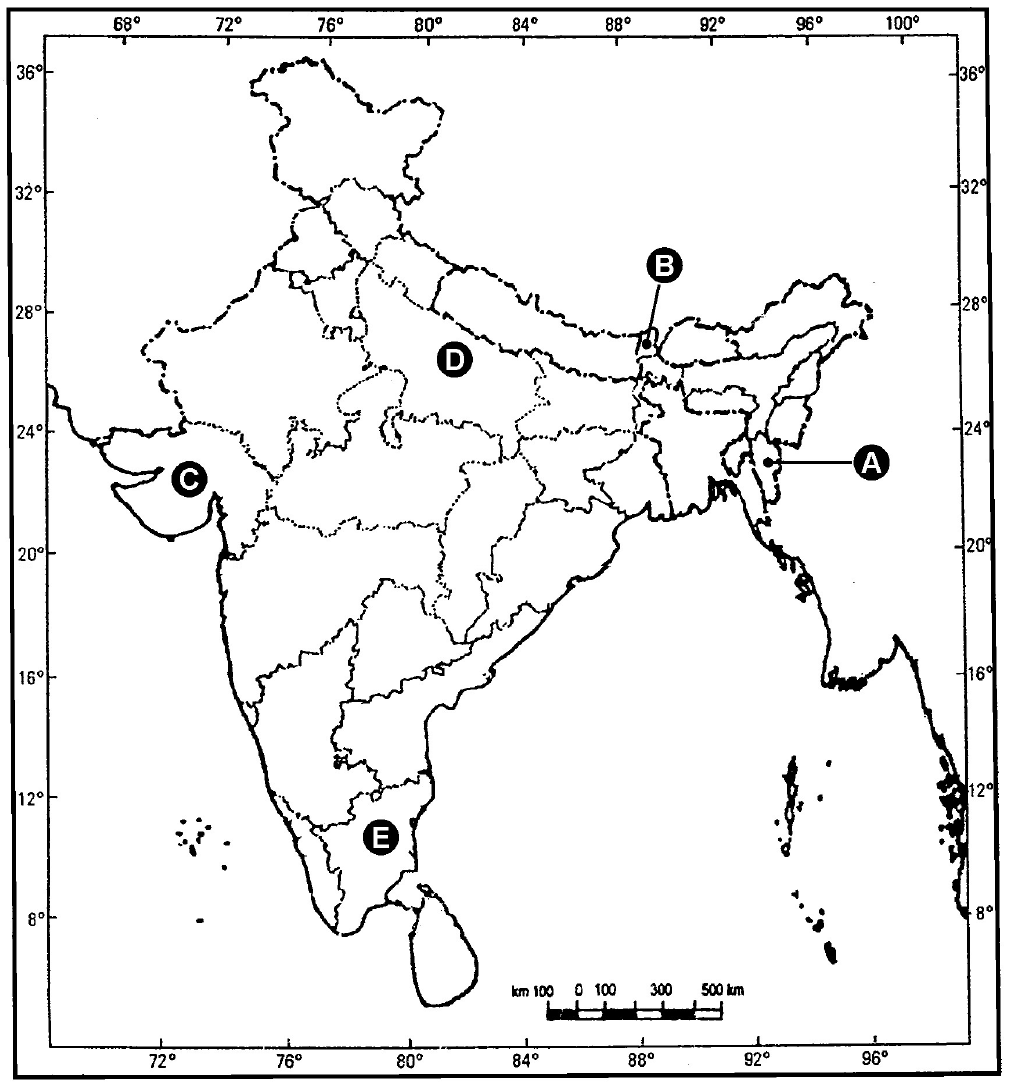
In the political outline map of India given above, five states have been marked as A, B, C, D and E. Identify these states on the basis of information given below and write their correct names in your answer book along with the respective serial number of the information used and the concerned alphabet in the map as per the following format.
Sr. No. of the information used
Concerned alphabet in the Map
Name of the State
i.
 
 
ii.
 
 
iii.
 
 
iv.
 
 
v.
 
 
  1. The state where a violent incident took place at Godhara in $2002$.
  2. The state which was earlier known as Madras.
  3. The state which has the maximum number of seats in India in its Legislative Assembly.
  4. The state to which Laldenga belonged.
  5. The state which integrated with India in $1975$ as $22^{nd}$ State of India.
Read the passage given below and answer the following questions:
The interim government took a firm stance against the possible division of India into smaller principalities of different sizes. The Muslim League opposed the Indian National Congress and took the view that the States should be free to adopt any course they liked. Sardar Patel, India's Deputy Prime Minister and the Home Minister during the crucial period, immediately after Independence, played a historic role in negotiating with the rulers of Princely States in bringing most of them into the Indian Union.
  1. Which government has been referred to as the interim government?
  2. Why did the Muslim League oppose the Indian National Congress?
  3. What makes the role of Sardar Patel a historic one? Explain.