Question
How do different senses work in frog? Explain in brief.

Answer

Sense Organs in Frog: Frog has different types of sense organs which are as follows:
  1. Sensory papillae or organs of touch.
  2. Taste buds.
  3. Nasal epithelium for the sense of smell.
  4. Eyes for vision and us.
  5. Tympanum with internal ears for hearing.
Out of these, eyes and internal ears are well-organised structures and the rest are cellular aggregations around nerve endings. Eyes in a frog are a pair of spherical structures situated in the orbit in skull. These are simple eyes. External ear is absent in frogs and only tympanum can be seen externally. The ear is an organ of hearing as well as balancing.

Need a full question paper?

Generate a complete, print-ready paper with questions like this in minutes — across 16+ boards, with answer keys.
Start Generating Free

Similar questions

Find examples where the four daughter cells from meiosis are equal in size and where they are found unequal in size.
Each plant or group of plants have some phylogenetic significance in relation to evolution: Cycas, one of the few living members of gymnosperms is called as the 'relic of past'. Can you establish a phylogenetic relationship to Cycas with any other group of plants that justifies the above statement?
What are three major types of cells found in the gastric glands? Name their secretions.
Why is there no mixing of deoxygenated and oxygenated blood in the human heart normally?
On world AiDs day Ankit and his friends arranged an awareness compaign programme in their locality. Some elderly people rebuked the children and asked them not to talk of such things in public. The children convinced the elders about the need ror the programme and on understanding their point of view, they also joined the campaign.
  1. What is AIDS?
  2. Name the causal agent of AIDS.
  3. What type of genetic material is found in AIDS virus?
  4. What values did Ankit and his friends show on the occasion.
  1. Name the instrument used to obtain the ECG of a person.
  2. How many electrical leads connect the patien to the instrument? Mention the parts of the body connected.
Why is purification of water and nutrient salts so important in studies involving mineral nutrition using hydroponics?
During a visit to a botanical garden, the teacher showed students an old tree which was on the verge of extinction. As soon as the teacher left, some notorious students climbed up the tree and started cutting the branches, collecting its leaves as previous collection. Saumya instead took photographs from various angles. The boys mocked at Saumya, while the teacher appreciated her.
  1. Why should we conserve biodiversity?
  2. What role is played by botanical garden in the conservation of biodiversity?
  3. Who besides botanists look after plants in botanical gardens?
  4. What values did Saumya possess?

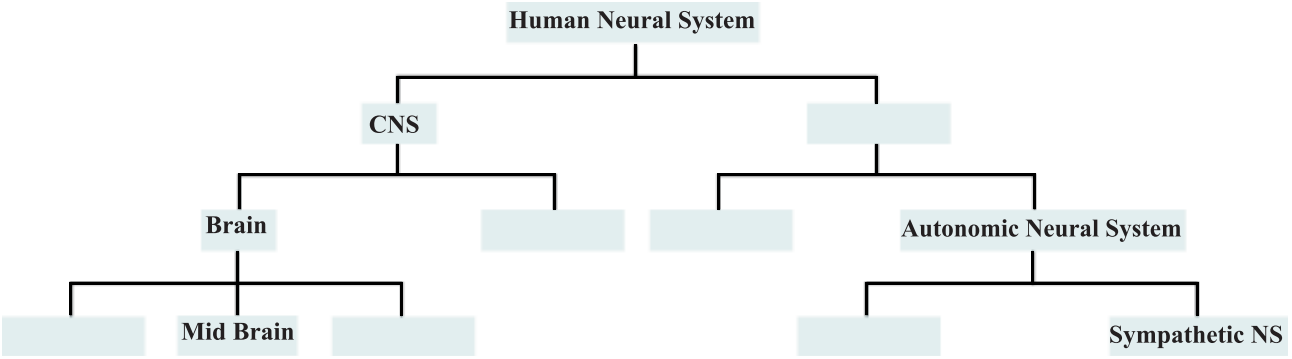
The major parts of the human neural system is depicted below. Fill in the empty boxes with appropriate words.
Give comparison between the following: Anatomy of leaf in $\mathrm{C}_3$ and $\mathrm{C}_4$ plants