Question
How do fossils help us in understanding the evolutionary history?

Answer

  1. Fossils in different sedimentary layers indicate the geological period in which they existed.
  2. They show that life forms varied over time.
  3. New forms of life have arisen at different times in the history of earth.

Need a full question paper?

Generate a complete, print-ready paper with questions like this in minutes — across 16+ boards, with answer keys.
Start Generating Free

Similar questions

Are parthenocarpy and apomixis different phenomena? Discuss their benefits.
Hint: Yes, they are different. Parthenocarpy leads to development of seedless fruits. Apomixis leads to embryo development. 
Reproductive and Child Healthcare (RCH) programmes are currently in operation. One of the major tasks of these programmes is to create awareness amongst people about the wide range of reproduction related aspects. As this is important and essential for building a reproductively healthy society.
  1. 'Providing sex education in schools is one of the way to meet this goal'. Give four points in support of your opinion regarding this statement.
  2. List any two 'indicators' that indicate a reproductively healthy society.
The blood group of a man is A and his wife has the blood group O. Which blood group will the children not have? Justify your answer also.
What is cleavage?
Is an aquarium a complete ecosystem?
Explain the primary productivity of ecosystem.
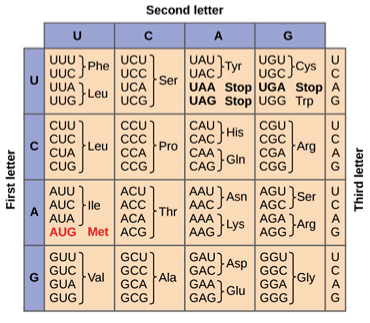
Observe the diagram of Genetic code and answer the following questions:
Image
i. How many codons codes for amino acids and how many do not?
ii. Explain the following giving one example of each.
a. Unambiguous and specific codon
b. Degeneration codon
c. Universal codon
d. Initiator codon
Rearrange the following in the correct sequence to accomplish an important biotechnological reaction:
  1. In vitro synthesis of copies of DNA of interest,
  2. Chemically synthesised oligonucleotides,
  3. Enzyme DNA-polymerase,
  4. Complementry region of DNA,
  5. Genomic DNA template,
  6. Nucleotides provided,
  7. Primers,
  8. Thermostable DNA-polymers (From Thermus aquaticus),
  9. Denaturation of dsDNA.
Explain the roles of the following with the help of an example each in recombinant DNA technology:
  1. Restriction Enzymes.
  2. Plasmids.
Write any four differences between Vasa efferentia and Vasa deferentia.