Question
How do metals differ from non-metals in :
(i) ion formation
(ii) electronic configuration
(iii) chemical nature of their oxides?

Answer

(i) Metals form positively charged ions, whereas non-metals form negatively charged ions.
(ii) Metals have 1 to 3 electrons in their valence shells, whereas non-metals have 4 to 7 electrons in their valence shells.
(iii) The oxides of metals are basic in nature, whereas oxides of non-metals are acidic or neutral in nature.

Need a full question paper?

Generate a complete, print-ready paper with questions like this in minutes — across 16+ boards, with answer keys.

Start Generating Free

Similar questions

You are provided with the list of chemicals below in the box:
Image
Using suitable chemicals from the list given below, write balanced chemical equations for the preparation of the salts mentioned below:
(i) Lead carbonate
(ii) Ammonium sulphate

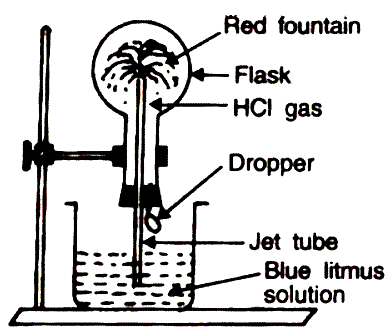
(a) Name the experiment illustrate above.
(b) Which property of hydrogen chloride is demonstrated by this experiment?
(c) State the colour of the water that has entered the round-bottomed flask.
How is electrolytic dissociation different from thermal dissociation?
Explian the following :
Dil. HCl acid is stronger than highly concentrated acetic acid.
State your observation when:
Zinc chloride solution, zinc nitrate solution, and zinc sulphate solutions are added individually to
(i)Barium chloride solution
(ii)Lead nitrate solution.
Given that the relative molecular mass of copper oxide is $80,$ what volume of ammonia $($measured at $\text{STP})$ is required to completely reduce $120g$ of copper oxide? The equation for the reaction is :
$3CuO + 2NH_{3 }\rightarrow 3Cu + 3H_2O + N_2$
In order to obtain ½ tonne of aluminium, the following inputs are required :
Bauxite (2 tonnes); sodium hydroxide (75 kg); graphite (300 kg).
The compound of aluminium in bauxite is aluminium oxide and the main impurity is iron (III) oxide. The aluminium is obtained by the electrolysis of aluminium oxide in dissolved cryolite.
(a) When bauxite is treated with sodium hydroxide solution, what happens to the :
(i) aluminium oxide (ii) iron (III) oxide
(b) (i) Name the process used for the purification of bauxite.
(ii) Write the action of heat on aluminium hydroxide.
Calculate:
The volume of $4g$ of $H_2$ at $4$ atmospheres.
A compound is formed by $24g$ of $X$ and $64g$ of oxygen. If the atomic mass of $X=12$ and $O=16$, calculate the simplest formula of the compound.
Write the observation, and balanced equation for the following reaction:
A paper dipped in potassium permanganate solution is placed at the mouth of a test tube, containing sulphur dioxide gas.