Question
How do metals reacts with dilute acids? Explain with the help of an example.

Answer

When a metal reacts with dilute acid, salts are formed. During this reaction hydrogen gas is evolved. In other words, when a metal is added to dilute acids, salt and hydrogen gas are formed.
Process: Sulfate salts and chloride salts are formed when metals react with dilute sulfuric acid and hydrochloric acid. Some metals reacts vigorously with dilute sulfuric acid or hydrochloric acid for example, potassium, sodium, lithium and calcium.
Need a full question paper?

Generate a complete, print-ready paper with questions like this in minutes — across 16+ boards, with answer keys.

Start Generating Free

Similar questions

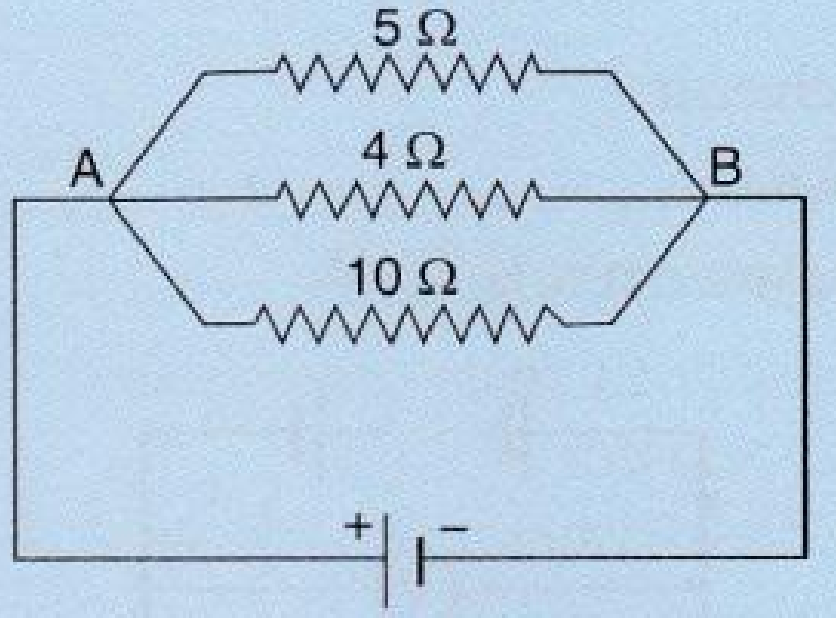
In the circuit diagram given below, the current flowing across 5 ohm resistor is 1 amp. Find the current flowing through the other two resistors.
The electrical resistivities of three materials P, Q and R are given below:$\begin{matrix}\text{P}&2.3\times10^{3}\Omega\text{ m}\\\text{Q}&2.63\times10^{-8}\Omega\text{ m}\\\text{R}&1.0\times10^{15}\Omega\text{ m}\end{matrix}$
Which material will you use for making:
  1. Electric wires.
  2. Handle for soldering iron, and
  3. Solar cells?
Give reasons for your choices.
State Fleming’s left-hand rule. Explain it with the help of labelled diagrams.
The strategy of 3Rs' has become profound in environment management programme. Give reason.
  1. An object 3cm high is placed 24cm away from a convex lens of focal length 8cm. Find by calculations, the position, height and nature of the image.
  2. If the object is moved to a point only 3 cm away from the lens, what is the new position, height and nature of the image?
  3. Which of the above two cases illustrates the working of a magnifying glass?
Give reason for the following:
  1. Which has low melting point.
  2. Which exist in liquid state at room temperature.
  3. Which is most abundant in earth's crust.
  4. Which is placed at the top of the reactivity series.
State the three common features of all the respiratory organs like skin, gills and lungs.
An object 2cm tall is placed on the axis of a convex lens of focal length 5cm at a distance of 10m from the optical centre of the lens. Find the nature, position and size of the image formed. Which case of image formation by convex lenses is illustrated by this example?
What is a seed? What are the parts of a seed? Explain with the help of a labelled diagram.
What is a solar cell? Draw the labelled diagram of a solar cell.