Question
How do polar solvents help in the first step in $S_N1$ mechanism?

Answer

$S_N1$ occurs in two steps.
In step I, the polarised $C—Br$ bond undergoes slow cleavage to produce a carbocation and a halide ion.
Step II involves the attack of nucleophile upon the carbocation thus formed to complete the substitution reaction.
Since 'step $I'$ is slowest and reversible. It causes breaking of $C—X$ bond, for which the energy is obtained through solvation of halide ion with the proton of protic solvent.

Need a full question paper?

Generate a complete, print-ready paper with questions like this in minutes — across 16+ boards, with answer keys.
Start Generating Free

Similar questions

Write the mechanism of the reaction of HI with methoxymethane.
Explain the mechanism of addition of HCl to propene.
Describe the following giving the relevant chemical equation in each case:
  1. Carbylamine reaction.
  2. Hofmann's bromamide reaction.
Note: In the following questions a statement of assertion followed by a statement of reason is given. Choose the correct answer out of the following choices.
  1. Both assertion and reason are true and the reason is the correct explanation of assertion.
  2. Both assertion and reason are true and the reason is not the correct explanation of assertion.
  3. Assertion is true but the reason is false.
  4. Both assertion and reason are false.
  5. Assertion is false but reason is true.
Assertion: Cu is less reactive than hydrogen.
Reason: $\text{E}^{\ominus}_{\text{Cu}^{2+}/\text{Cu}}$ is negative.
Use Hund's rule to derive the electronic configuration of Ce3+ ion, and calculate its magnetic moment on the basis of 'spin-only' formula.
Calculate the freezing point of a solution containing $60g$ of glucose $($Molar mass $= 180g mol^{-1})$ in $250g$ of water.
$(K_f $ of water $= 1.86K \ kg mol^{-1})$
Note: In the following questions a statement of assertion followed by a statement of reason is given. Choose the correct answer out of the following choices.
Assertion: Electrolysis of $\ce{NaCl}$ solution gives chlorine at anode instead of $O_2.$
Reason: Formation of oxygen at anode requires overvoltage.
Anhydrous $CuSO _4$ is white but hydrated $CuSO _4$ is blue while both contain $Cu ^{2+}$ ions. Why?
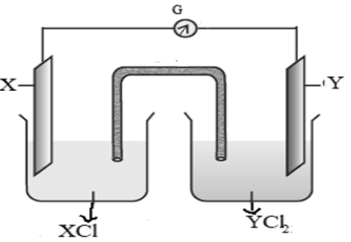
Observe the following cell and answer the questions that follow:
Image
a. Represent the cell shown in the figure.
b. Name the carriers of the current in the salt bridge
c. Write the reaction taking place at the anode.
Match the common names given in Column I with the IUPAC names given in Column II.
 
Column I
(Common names)
 
Column II
(IUPAC names)
(i)
Cinnamaldehyde
(a)
Pentanal
(ii)
Acetophenone
(b)
Prop-2-enal
(iii)
Valeraldehyde
(c)
4-Methylpent-3-en-2-one
(iv)
Acrolein
(d)
3-Phenylprop-2-enal
(v)
Mesityl oxide
(e)
1-Phenylethanone