Question
How do you balance the chemical equation? Explain it stepwise with suitable illustration.

Answer

Consider the following equation:
$Fe+H_2 O \rightarrow Fe_3 O_4+H_2$
Steps for balancing the equation are as follows:
Step 1: To balance a chemical equation, first place each formula in the box. Do not change anything inside the box during balancing the equation.
Image
Step 2: List the number of atoms of given elements present in the unbalanced equation (1.1).
ElementNumber of atoms in reactantsNumber of atoms in products
Fe13
H22
O14
Step 3: Select the compound having maximum number of atoms and balance the elements which have higher number of atoms.
Here, first balancing the number of oxygen atoms of Fe3O4.
Atoms of oxygenIn reactantsIn Products
(1) Initial$\ 1(in \quad H_2 O)$$4 (in \quad Fe _3 O _4)$
(2) To balance$1 \times 4$4
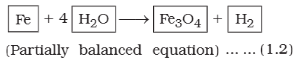
Here, it must be remembered that during balancing the atoms, do not alter the chemical formulae. For example, to balance the oxygen atoms, place co-efficient 4 before H2O, but do not write H2O4 ог (Н2О)4. Hence, equation (1.1) can be written as -
Image
Step 4: H and Fe atoms are still not balanced in equation (1.2). Now balance the H atoms. To equalise the number of H atoms, multiply the number of molecules of H2 by 4 in right side.
Atoms of hydrogenIn reactantsIn products
(1) Initial$8\left(\right.$ in $\left.4 H _2 O \right)$$2\left(\right.$ in $\left.H _2\right)$
(2) To balance8$2 \times 4$
Now, equation (1.2) can be written as follows:
Image
Step 5: Fe atoms are still not balanced in equation (1.3). To equalise the number of Fe atoms, Multiply the Fe by 3 on left side. Hence, equation (1.3) will be as-
Image
Step 6: Remove boxes $ (\square)$
$3 Fe +4 H _2 O \rightarrow Fe _3 O _4+4 H _2$ (Balanced equation)...... (1.4)
The number of atoms on both sides of equation (1.4) are equal. This is called balanced chemical equation. This method of balancing the chemical equations is called hit-and-trial method.
Step 7: Physical states of the substances are mentioned along with their symbols to make the chemical equation more informative. Symbols (g) for gases, (l) for liquids. (s) for solids and (aq) for aqueous solution are written.
Thus, equation (1.4) will be written as-
$3 Fe(s)+4 H_2 O(g) \longrightarrow Fe_3 O_4(s)+4 H_2(g)$
Sometime, the reaction conditions such as temperature, pressure, catalyst, if any, are represented above and/or below the arrow.
For example,
$CO ( g )+3 H _2(g) \xrightarrow{340 atm} CH _3 OH ( l )$$6 CO _2(g)+6 H _2 O ( l ) \xrightarrow[\text { Chlorophyll }]{\text { Sunlight }} \underset{\text { Glucose }}{ C _6 H _{12} O _6( aq )}+{ O _2(g)}{ }$

Need a full question paper?

Generate a complete, print-ready paper with questions like this in minutes — across 16+ boards, with answer keys.
Start Generating Free