Question
How does a Cash Book serve 'Dual Purpose?

Answer

It is both a subsidiary book (book of original entry) and a principal book. When a cash book is maintained, transactions of cash are not recorded in the journal. As all the cash transactions are recorded for the first time in the cash book, it is therefore a book of original entry. But when a cash book is prepared, cash account in the ledger is not prepared. In this way, cash book represents the cash account and hence, becomes the principal book of accounts. As such, the cash book is a subsidiary book as well as principal book.
Need a full question paper?

Generate a complete, print-ready paper with questions like this in minutes — across 16+ boards, with answer keys.

Start Generating Free

Similar questions

Prepare the Accounting Equation on the basis of the following:
  1. Started business with cash ₹ 1,40,000 and Stock ₹ 2,50,000.
  2. Sold goods (costing ₹ 50,000) at a profit of 25% on the cost.
  3. Deposited into bank account ₹ 1,80,000.
  4. Purchased goods from Mohan ₹ 80,000.
How does a Cash Book serve 'Dual Purpose?
Pass Journal entries rectifying the following errors:
  1. A cheque for ₹ 10,000 was received from Ranjan on which ₹ 200 Cash Discount was allowed. The cheque was not honoured on due date and the amount of discount was credited to Discount Received Account.
  2. ₹ 2,000 paid as wages for machinery installation was debited to Wages Account.
  3. ₹ 5,000 received from Rakesh were credited to his Personal Account. The amount had been written off as bad debts earlier.
  4. Repair bill of machinery was recorded as ₹ 100 against the bill amount of ₹ 1,000.
The cash book shows a bank balance of ₹ 7,800 . On comparing the cash book with the passbook the following discrepancies were noted:
i. Cheque deposited in bank but not credited ₹ 3,000
ii. Cheque issued but not yet present for payment ₹ 1,500
iii. An insurance premium paid by the bank ₹ 2,000
iv. Bank interest credit by the bank ₹ 400
v. Bank charges ₹ 100
vi. Directly deposited by a customer ₹ 4,000
Prepare Accounting Equation from the following:
  1. Started business with cash ₹ 1,00,000.
  2. Purchased goods for cash ₹ 20,000 and on credit ₹ 30,000.
  3. Sold goods for cash costing ₹ 10,000 and on credit costing ₹ 15,000 both at a profit of 20%.
  4. Paid salaries ₹ 8,000.
How will be the following errors rectified?
  1. Purchases Book is overcasted by ₹ 10,000.
  2. Purchases Return Book is overcasted by ₹ 1,000.
  3. Purchases Return Book’s balance is carried forward in excess by ₹ 100.
  4. Purchases Book’s balance is carried forward in excess by ₹ 1,000.
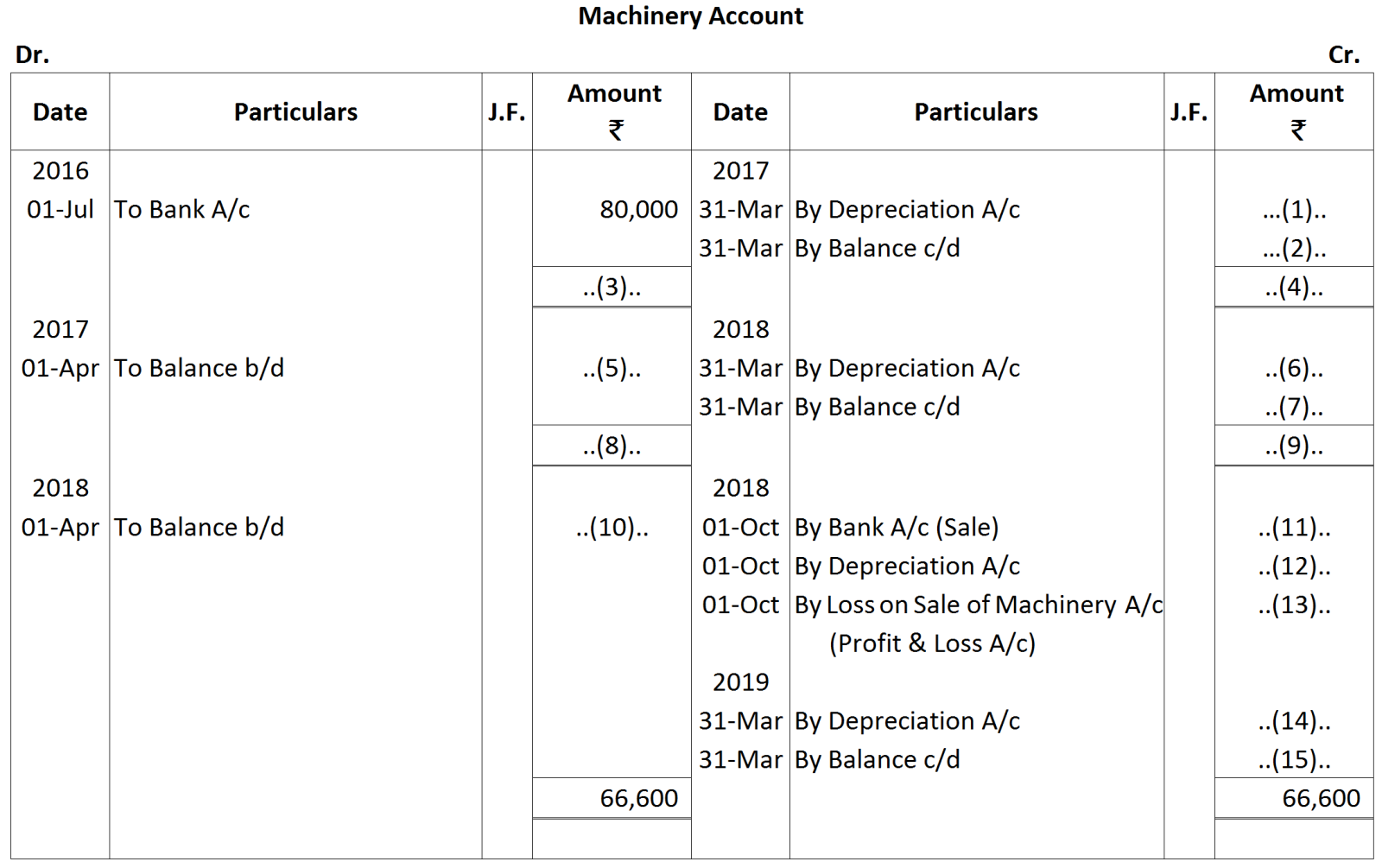
In the following Machinery Account, determine the missing values, if depreciation is to be charged @ 10% p.a. per Diminishing Balance Method. On 1st October, 2018, a part of the machinery valued in the books of the firm at ₹ 16,000 on 1st July, 2016 was sold for ₹ 10,000.
Prepare Accounting Equation from the following:
  1. Started business with Cash ₹ 2,00,000.
  2. Purchased goods for Cash ₹ 60,000 and on Credit ₹ 1,50,000.
  3. Sold goods for Cash costing ₹ 40,000 at a profit of 20% and on Credit costing ₹ 72,000 at a profit of 25%.
  4. Paid for Rent ₹ 5,000.
Distinguish Trade Discount from Cash Discount. (Two points)
Name the books of original entry where the following transactions will be recorded with reasons thereof:
  1. Goods purchased from Ram Lal for ₹ 5,000 on credit.
  2. Provision for doubtful debts created @ 5% on debtors with books value of ₹ 10,000.
  3. Defective goods sold to Babita on credit worth ₹ 4,000 were returned by her.
  4. Purchased furniture on credit from Mr. Ratan Singh for ₹ 15,000 for use in the business.