Question
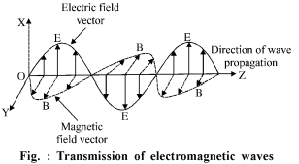
How does a charge oscillating with any frequency produces electromagnetic waves? Draw a schematic diagram by showing electric and magnetic fields for an electromagnetic wave transmitting along Z-axis.
Answer

When a charge oscillates with any frequency then it produces an electric field oscillating from that place. This produces an oscillating magnetic field. Oscillating magnetic field becomes a source to produce electric field and this process continues. In this way the electric and magnetic field vectors producing each other are mutually perpendicular to each other and also to the direction of propagation of wave.
Image

Need a full question paper?

Generate a complete, print-ready paper with questions like this in minutes — across 16+ boards, with answer keys.
Start Generating Free

Similar questions

Light of frequency $7.21 \times 10^{14} Hz$ is incident on a metal surface. Electrons with a maximum speed of $6.0 \times 10^5\ m/s$ are ejected from the surface. What is the threshold frequency for photoemission of electrons?
Obtain the formula for the electric field due to a long thin wire of uniform linear charge density λ without using Gauss’s law.
[Hint: Use Coulomb’s law directly and evaluate the necessary integral.]
A body rotating at $20 \ \text{rad/s}$ is acted upon by a constant torque providing it a deceleration of $2\ce{rad/s}^2$. At what time will the body have kinetic energy same as the initial value if the torque continues to act?
What do electromagnetic waves consist of ? Explain on what factors does its velocity in vacuum depend?
A 60\ kg man skating with a speed of $10m/s$ collides with a $40\ kg$ skater at rest and they cling to each other. Find the loss of kinetic energy during the collision.
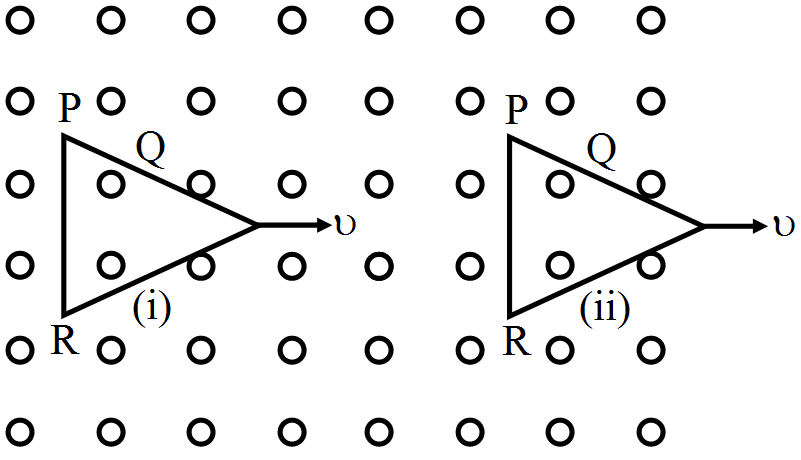
Fig. shows two positions of a loop PQR in a perpendicular uniform magnetic field. In which position of the coil is there an induced emf?
A charged particle having a charge of $-2.0 \times 10^{-6}C$ is placed close to a nonconducting plate having a surface charge density $4.0 \times 10^{-5}Cm^{-2}.$ Find the force of attraction between the particle and the plate.
In an accelerator experiment on high$-$energy collisions of electrons with positrons, a certain event is interpreted as annihilation of an electron$-$positron pair of total energy $10.2\ BeV$ into two $γ-$rays of equal energy. What is the wavelength associated with each $γ-$ray? $(1\ BeV = 10^9\ eV)$.
A simple pendulum of length (l) is pulled aside to make an angle $\theta$ with the vertical. Find the magnitude of the torque of the weight (w) of the bob about the point of suspension. When is the torque zero?
The equation of a wave travelling on a string is:$\text{y}=(0.10\text{mm})\sin\big[(31.4\text{m}^{-1})\text{x}+(314\text{s}^{-1})\text{t}\big].$
  1. In which direction does the wave travel?
  2. Find the wave speed, the wavelength and the frequency of the wave.
  3. What is the maximum displacement and the maximum speed of a portion of the string?