Question
  1. How does a chromosomal disorder differ from a Mendelian disorder?
  2. Name any two chromosomal aberration associated disorders.
  3. List the characteristics of the disorders mentioned above that help in their diagnosis.

Answer

  1. Mendelian disorders are mainly determined by the alteration or mutation in the single gene. These mutations are transmitted to the offspring. On the other hand, Chromosomal disorders are caused due to absence or excess of one or more chromosomes.
  2. The two chromosomal aberrations that are most commonly seen are Down's syndrome (trisomy of 21st chromosome) and Turner's syndrome (absence of one of the X chromosome i.e. 45 + X0).
  3. The characteristics of the two chromosomal disorders are as follows:
  1. Characteristics of Down's syndrome are furrowed tongue, partially opened mouth, broad palm with characteristic palm creases, short-statured, small round head physical, psychomotor and mental development is retarded.
  2. Characteristics of Turner's syndrome are sterile or rudimentary ovary, lack of secondary sexual characteristics. It occurs only in females.

Need a full question paper?

Generate a complete, print-ready paper with questions like this in minutes — across 16+ boards, with answer keys.

Start Generating Free

Similar questions

Himani while watching a TV programme based on life in polar region observed that all animals in polar regions possess larger size. Also, smaller animals are not found in that region. She asked about this surprising fact to her teacher.
  1. Why smaller animals (e.g. humming birds) are rarely found in polar regions?
  2. What are the adaptations shown by polar animals?
  3. What are the chief characteristics of polar region animals?
  4. What values are shown by Himani?
Name the law that states that the sum of allelic frequencies in a population remains constant. What are the five factors that influence these values?
Describe in detail the origin and evolution of human?
What is meant by immunity? What are the four barriers to innate immunity? Explain . Draw a labelled diagram of the structure of an antibody molecule.
Write the components of nucleotide. Write one important feature of the structure of double helical DNA. Draw a labelled diagram of double helical DNA.
Answer the following questions:
You are given tall pea plants with yellow seeds whose genotypes are unknown. How would you find the genotype of these plants? Explain with the help of cross.
  1. What is an age pyramid?
  2. Explain with the help of figures, the three different types of age pyramids represented by human population.
The melding of a technique for repeated rounds of DNA synthesis with the discovery of a thermostable DNA polymerase has given scientists the very powerful technique known as polymerase chain reaction (PCR). PCR is based on three simple steps required for any DNA synthesis reaction: (1) denaturation of the template into single strands; (2) annealing of primers to each original strand for new strand synthesis; and (3) extension of the new DNA strands from the primers.
In the given figure, one cycle of polymerase chain reaction (PCR) is shown:
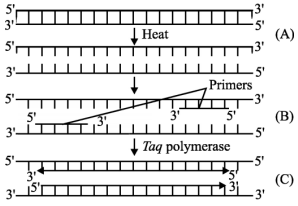
Image
i. Name the steps A, B and C.
ii. Give the purpose of each of these steps.
iii. State the contribution of Thermus aquaticus in this process.
Define ecological pyramids and describe with examples, pyramids of number and biomass.
Taking a small pond as an example of an ecosystem, list the four components of this ecosystem. How do these components function as a unit in a small pond?