Question
How does fertilisation take place? Fertilisation occurs once in a month. Comment.

Answer

Fusion of male gamete sperm and female gamete egg in fallopian tube (oviduct) is called as fertilization. The process starts with introduction of sperms, produced in testes of male, into the vagina of the woman through penis during copulation or mating. Highly active and mobile sperms pass from cervix through the uterus into the oviducts. Ovulation, in female, releases ovum in oviduct. Irrespective of release of millions of sperms into the vagina at one time, only one sperm fuses with the ovum in the oviduct to form a zygote i.e. fertilization.
Ovulation is release of ovum from ovary into oviduct and takes place only once in a month i.e. 14$^{th}$ day of menstrual cycle. Hence, fertilization can occur only once in a month.

Need a full question paper?

Generate a complete, print-ready paper with questions like this in minutes — across 16+ boards, with answer keys.
Start Generating Free

Similar questions

How do Mendel’s experiments show that traits are inherited independently?
Describe the activity that shows that a current-carrying conductor experiences a force perpendicular to its length and the external magnetic field. How does Fleming’s left-hand rule help us to find the direction of the force acting on the current carrying conductor?
Redraw the circuit of Question 1, putting in an ammeter to measure the current through the resistors and a voltmeter to measure the potential difference across the 12 Ω resistor. What would be the readings in the ammeter and the voltmeter?
What is long-sightedness? State the two causes of long-sightedness (or hypermetropia). With the help of ray diagrams, show:
  1. The eye-defect long-sightedness.
  2. Correction of long-sightedness by using a lens.
  1. Define the following terms in the context of spherical mirrors:
  1. Pole.
  2. Centre of curvature.
  3. Radius of curvature.
  4. Principal axis.
  1. Draw ray diagrams to show the principal focus of (i) a concave mirror, and (ii) a convex mirror.
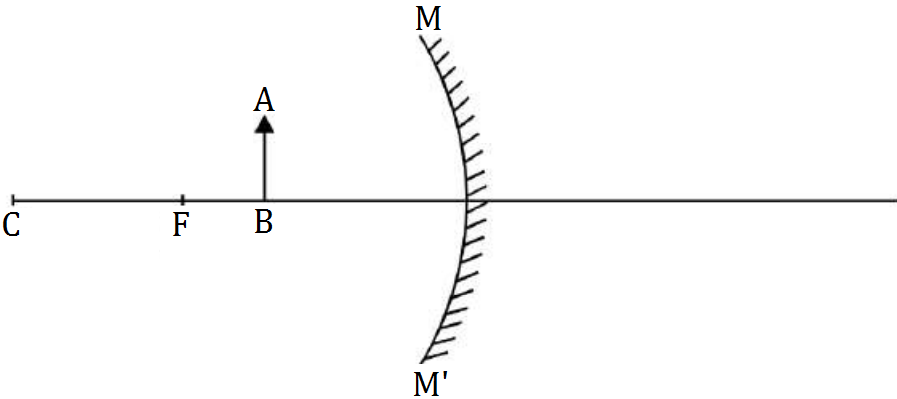
  2. In the following diagram, MM' is a concave mirror and AB is an object. Draw on your answer-sheet a ray diagram to show the formation of image of this object.
What are the different methods of contraception?
During the respiration of an organism A, 1 molecule of glucose produces 2 ATP molecules whereas in the respiration of another organism B, 1 molecule of glucose produces 38 ATP molecules.
  1. Which organism is undergoing aerobic respiration?
  2. Which organism is undergoing anaerobic respiration?
  3. Which type of organism, A or B, can convert glucose into alcohol?
  4. Name one organism which behaves like A.
  5. Name two organisms which behave like B.
A filamentous alga X is found in ponds, lakes and slow-moving streams. The filament of this alga simply breaks into two (or more) pieces on maturing and each piece then grows to become a complete new alga.
  1. Name an alga which X is likely to be.
  2. What is the colour of X?
  3. What is the method of forming new algae by the breaking of parent alga known as?
  4. An Amoeba also breaks up to form two daughter Amoebae. What is the difference in the splitting of Amoeba and splitting of this alga as a method of reproduction?
  5. Name one marine animal which reproduces in the same way as alga X.
The organs A of a person have been damaged completely due to which too much of a poisonous waste material B has started accumulating in his blood, making it dirty. In order to save this person's life, the blood from an artery in the person's arm is made to flow into long tubes made of substance E which are kept in coiled form in a tank containing solution F. This solution contains three materials G, H and I in similar proportions to those in normal blood. As the person's blood passes through long tubes of substance E, most of the wastes present in it go into solution. The clean blood is then put back into a vein in the arm of the person for circulation.
  1. What are organs A?
  2. Name the waste substance B.
  3. What are (i) E and (ii) F? Name G, H and I.
  4. What is the process described above known as?
Draw a neat labelled diagram of the human excretory system.