Question
How HIV multiplies in the host body?

Answer

HIV enters into macrophages and its RNA replicates with the host's cell DNA, so the infected cells produce virus particles and finally act as HIV factory. Now HIV enters into T-lymphocytes to replicate and thus there is a decrease in number of Helper T-cells.

Need a full question paper?

Generate a complete, print-ready paper with questions like this in minutes — across 16+ boards, with answer keys.

Start Generating Free

Similar questions

Explain the significance of satellite DNA in DNA fingerprinting technique.
Explain the increase in the numbers of melanic (dark winged) moths in the urban areas of post-industrialisation period in England.
The below image shows is the headquarter of Eli Lilly company. Eli lily is one of the first pharmaceutical companies to produce human insulin using RDT technology by cell-based fermentation method.
Image
i. How did Eli Lilly synthesize human insulin?
ii. Mention one difference between this insulin and the one produce by the human pancreas.
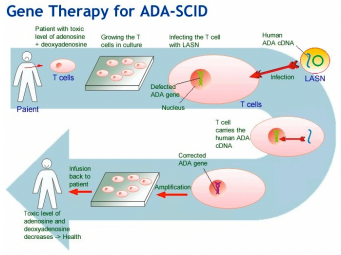
This image highlights the process of Gene Therapy of ADA-SCID.
Image
i. Mention the cause of ADA deficiency in humans.
ii. How has genetic engineering helped patients suffering from it?
Mention the various seral stages of xero sere.
What is Incomplete dominance. Explain the inheritance of colour in snapdragon flower up to $\mathrm{F}_{2}$ generation.
Answer the following questions:
Mention the problems that are taken care of by Reproduction and Child Health Care programme.
What could be the possible explanation for greater vulnerability of amphibians to extinction as compared to other animal groups?
The immune system of a person is suppressed. In the ELISA test, he was found positive to a pathogen.
  1. Name the disease the patient is suffering from.
  2. What is the causative organism?
  3. Which cells of body are affected by the pathogen?
  1. Draw the figure of vector pBR322 and label the following:
  1. Origin of replication.
  2. Ampicillin resistance site.
  3. Tetracycline resistance site.
  4. BamH1 restriction site.
  1. Identify the significance of origin of replication.