Question
How is a cathode ray beam affected while passing through a magnetic field?

Answer

A cathode ray beam while passing through a magnetic field is deflected in a direction normal to both the direction of magnetic field and the direction of its travel, as given by Fleming’s left hand rule.

Need a full question paper?

Generate a complete, print-ready paper with questions like this in minutes — across 16+ boards, with answer keys.
Start Generating Free

Similar questions

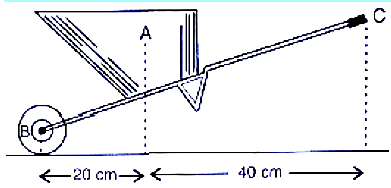
Fig 3.19 below shows a wheel barrow of mass $15 kg$ carrying a load of $30 kgf$ with its centre of gravity at A. The points B and C are the centre of wheel and tip of the handle such that the horizontal distance $A B=20 cm$ and $A C=40 cm$.


Calculate: (i) the load arm, (ii) the effort arm, (iii) the mechanical advantage and (iv) the minimum effort required to keep the leg just off the ground.
A block and tackle system of pulleys has a velocity ratio of 4.
(i) Draw a labelled diagram of the system indicating clearly the points of application and directions of load and effort.
(ii) What is the value of the mechanical advantage of the given pulley system if it is an ideal pulley system?
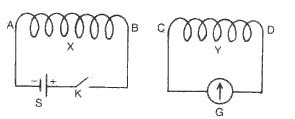
The diagram 10 shows two coils X and Y. The coil X is connected to a battery S and a key K. The coil Y is connected to a galvanometer G.

Image

When the key K is closed. State the polarity
(i)At the end of the coil X,
(ii)At the end C of the coil Y,
(iii)At the end C of the coil Y if the coil Y is (a) Moved towards the coil X, (b) Moved away from the coil X.

An electric bulb is rated at 220 V, 100 W.
(a) What is its resistance?
(b) What safe current can be passed through it?
How is it possible to detect the filling of a pitcher under a tap by hearing its sound at a distance?
On what factors does the resistance of a conductor depend?
What is meant by equilibrium and state the conditions of equilibrium of a body?
State a relation between electrical power, resistance and potential difference in an electrical circuit.
How does the angle of deviation produced by a prism change with increase in the angle of incidence. Draw a curve showing the variation in the angle of deviation with the angle of incidence at a prism surface.
Name the atoms of a substance having same atomic number, but different mass numbers. Give one example of such a substance. How do the structures of such atoms differ?