Question
How is a covalent bond formed? Explain the rules of covalent bond formation with examples.

Answer

SELF

Need a full question paper?

Generate a complete, print-ready paper with questions like this in minutes — across 16+ boards, with answer keys.

Start Generating Free

Similar questions

S. No
Column I
Column II
1.
$[Mn(CO)_5]^-$
+6
2.
$[Mn_2(CO)_{10}]$
+2
3.
$K_4[Mn(CN)_6]$
0
4.
$K_2MnO_4$
-1
How the electrons was discovered? Explain
Give a brief description of the principles of the following techniques taking an example in each case.
Crystallisation
Arrange the following:
  1. During Clark's method, name the compound in which 'Mg' is precipated out?
  2. Give the formula of Zeolite used in ion exchange method to remove permanent hardness of water.
  3. Complete the following reaction:
$\text{BaO}_2.8\text{H}_2\text{O}(\text{s})+\text{H}_2\text{SO}_4(\text{aq})\xrightarrow{\ \ \ \ \ \ \ \ \ \ \ \ }$
  1. $H_2O_2$ is miscible with water. Assign reason.
  2. Name the compound which can be used as a hair bleach, mild antiseptic in form of perhydrol, as a rocket propellant in concentrated solution.
Comment on following :
(i) Differential extraction
(ii) Estimation of sulphur by Carius process
  1. What is the increasing order of the acidity of the compounds, $H_2O, H_2S$ and $H$, Se? Give reason for your answer.
  2. Complete and balance the following chemical equations:
    1. $\text{Na}+\text{D}_2\text{O}\xrightarrow{\ \ \ \ \ \ \ \ \ \ }$
    2. $\text{SO}_3+\text{D}_2\text{O}\xrightarrow{\ \ \ \ \ \ \ \ \ \ \ }$
    3. $\text{Na}_2\text{O}+\text{D}_2\text{O}\xrightarrow{\ \ \ \ \ \ \ \ \ \ }$
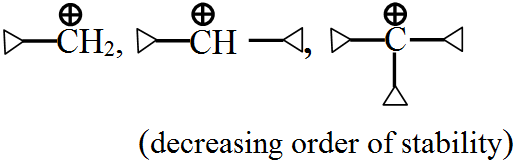
  1. Arrange the following according to given property
$\text{CH}_3\stackrel{\oplus \ \ \ }{\text{CH}}_2,\text{C}_6\text{H}_5-\stackrel{\oplus\ \ \ \ }{\text{CH}}_2,(\text{CH}_3)_3\stackrel{\oplus \ \ \ \ }{\text{CH}},$
$\text{CH}_2=\text{CH}-\stackrel{\oplus\ \ \ \ }{\text{CH}}_2$ (decreasing order of stability)
  1. $\text{HC}\equiv\text{C}^{\ominus},\text{Ch}_2=\stackrel{\ominus\ \ \ \ \ \ }{\text{CH}_2},\text{CH}_3-\stackrel{\ominus\ \ \ \ \ }{\text{CH}_2},\stackrel{\ominus \ \ \ \ \ }{\text{CH}_3}$ (increasing order of stabillity)
  2. $\text{C}_6\text{H}_5\stackrel{\bf. \ \ \ \ }{\text{CHCH}_3},\text{C}_6\text{H}_5\text{CH}_2\stackrel{\bf.\ \ \ \ \ }{\text{CH}_2},\text{C}_6\text{H}_5\stackrel{\bf.}{\text{C}}_3(\text{CH}_3)_2$ (increasing order of stabillity)
  3. $\text{CH}_3-\stackrel{\oplus \ \ \ \ }{\text{CH}}-\text{O}-\text{CH}_3,\text{CH}_3-\stackrel{\oplus \ \ \ \ }{\text{CH}},-\text{OCH}_3,$
${\ \ \ \ \ \ \ \ \ \ \ \ \ \ \ \ \ \ \ \ \text{O}}\\{\ \ \ \ \ \ \ \\ \ \ \ \ \ \ \ \ \ \ \ \ \ \\ \|}\\\ \text{CH}_3-\stackrel{\oplus \ \ \ \ }{\text{CH}}\text{C}-\text{OCH}_3$ (decreasing order of stability)
  1.  
On the basis of Le Chatelier principle explain how temperature and pressure can be adjusted to increase the yield of ammonia in the following reaction:
$
\begin{aligned}
& N_2(g)+3 H_2(g) \rightleftharpoons 2 NH_3(g) \\
& \Delta H=-92.38 kJmol^{-1}
\end{aligned}
$
What will be the effect of the addition of argon to the above reaction mixture at constant volume?
Explain redox reactions on the basis of electron transfer. Give suitable examples.
Bromine monochloride, BrCl decomposes into bromine and chlorine and reaches the equilibrium:$2\text{BrCl (g)}\rightleftharpoons\text{Br}_2\text{ (g) + Cl}_2\text{ (g)}$for which $K_c= 32$ at $500K$. If initially pure BrCl is present at a concentration of
$3.3 \times 10^{–3} mol L^{–1}$, what is its molar concentration in the mixture at equilibrium?