Question
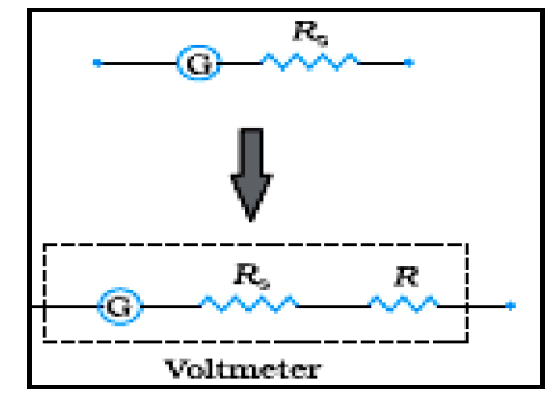
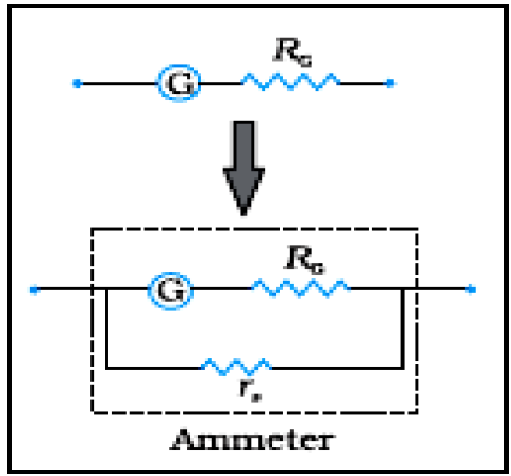
How is a galvanometer converted into a voltmeter and an ammeter? Draw the relevant diagrams and find the resistance of the arrangement in each case. Take resistance of galvanometer as G.
Answer

A galvanometer is converted into a voltmeter by connecting a high resistance ‘R’ in series with it. A galvanometer is converted into an ammeter by connecting a small resistance (called shunt) in parallel with it.


Resistance of voltmeter, 𝑅𝑉 = G + R
Resistance for Ammeter, $\text{R}_{A} = \frac{\text{G }\text{ r}_{s}}{\text{G} + \text{r}_{s}}$.

Need a full question paper?

Generate a complete, print-ready paper with questions like this in minutes — across 16+ boards, with answer keys.
Start Generating Free

Similar questions

Assume that each atom in a copper wire contributes one free electron. Estimate the number of free electrons in a copper wire having a mass of 6.4g (take the atomic weight of copper to be 64g mol-1.
A straight horizontal wire of mass 10mg and length 1.0m carries a current of 2.0A. What minimum magnetic field B should be applied in the region, so that the magnetic force on the wire may balance its weight?
Write down the Coulomb's law and get the vector form of it.
Explain electric potential energy difference and discuss its important points.
  1. Describe briefly the functions of the three segments of n-p-n transistor.
  2. Draw the circuit arrangement for studying the output characteristics of n-p-n transistor in CE configuration. Explain how the output characteristics is obtained.
  1. Define self inductance. Write its S.I. units.
  2. Derive an expression for self inductance of a long, solenoid of length l, cross sectional area A having N number of turns.
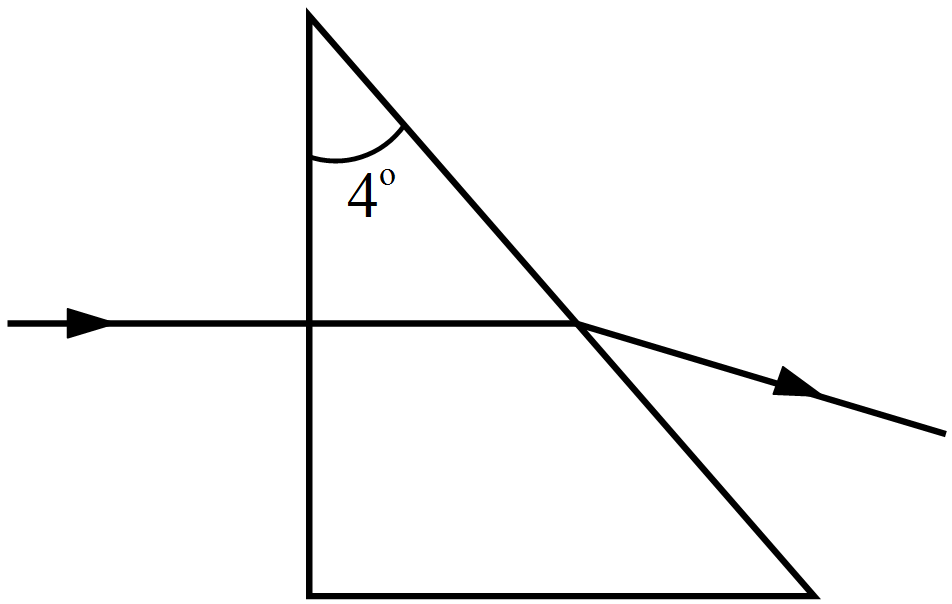
Find the angle of deviation suffered by the light ray shown in figure. The refractive index $\mu=1.5$ for the prism material.

There are energy bands in a solid. Do we have really continuous energy variation in a band or do we have very closely spaced but still discrete energy levels?
Two capacitors of capacitance $10\mu\text{F}$ and $20 \mu\text{F}$ are connected in series with a 6 V battery. After the capacitors are fully charged, a slab of dielectric constant (K) is inserted between the plates of the two capacitors. How will the following be affected after the slab is introduced:
  1. The electric field energy stored in the capacitors.
  2. The charges on the two capacitors.
  3. The potential difference between the plates of the capacitors.
Justify your answer.
A human body excretes (removes by waste discharge, sweating, etc.) certain materials by a law similar to radioactivity. If technetium is injected in some form in a human body, the body excretes half the amount in 24 hours. A patient is given an injection containing 99Tc. This isotope is radioactive with a half-life of 6 hours. The activity from the body just after the injection is $6\mu\text{Ci}.$ How much time will elapse before the activity falls to $3\mu\text{Ci}?$