Question
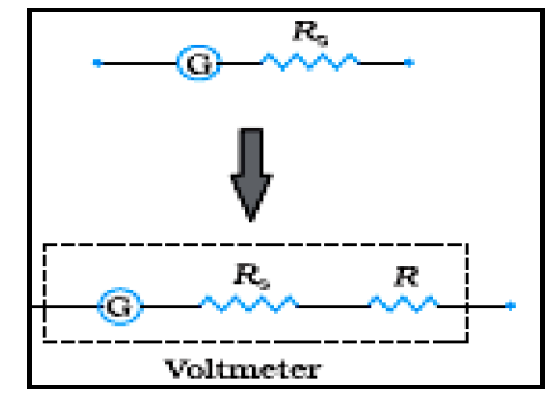
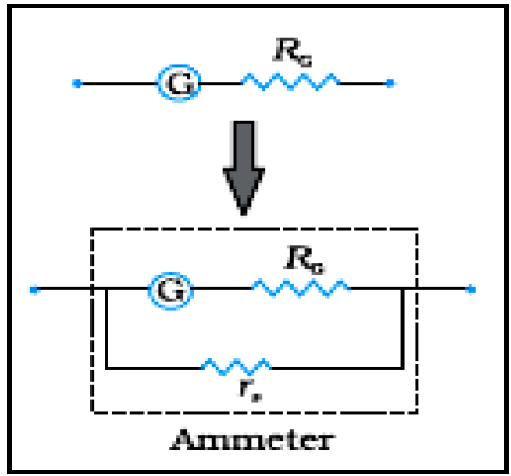
How is a galvanometer converted into a voltmeter and an ammeter? Draw the relevant diagrams and find the resistance of the arrangement in each case. Take resistance of galvanometer as G.
Answer

A galvanometer is converted into a voltmeter by connecting a high resistance ‘R’ in series with it. A galvanometer is converted into an ammeter by connecting a small resistance (called shunt) in parallel with it.


Resistance of voltmeter, $?_? = G + R$
Resistance for Ammeter, $\text{R}_{A} = \frac{\text{G }\text{ r}_{s}}{\text{G} + \text{r}_{s}}$.

Need a full question paper?

Generate a complete, print-ready paper with questions like this in minutes — across 16+ boards, with answer keys.

Start Generating Free

Similar questions

Four point charges $q_A = 2 \mu\ C, q_B = –5 \mu\ C, q_C = 2 \mu\ C,$ and $q_D = –5 \mu\ C$ are located at the corners of a square ABCD of side 10 cm. What is the force on a charge of 1 μC placed at the centre of the square?
Define atomic mass unit.
Two long parallel wires are 8 cm apart. Currents of magnitudes $i$ and $3 i$ are flowing in them respectively in the same direction. Where the resultant magnetic field due to two will be zero?
Magnitude of electric field of a plane electromagnetic wave is $40 V / m$ and it vibrates with a frequency of $2 \times 10^{10} s^{-1}$. Calculate the wavelength of the wave.
Assume that the mass of a nucleus is approximately given by $M = Am_p$ where A is the mass number. Estimate the density of matter in kg/m$^3$ inside a nucleus. What is the specific gravity of nuclear matter?
Which of the following will describe the smallest circle when projected with the same velocity perpendicular to the magnetic field B (i) $\alpha$-particle and (ii) $\beta$-particle?
A solenoid has a core of a material with relative permeability 400 . The windings of the solenoid are insulated from the core and carry a current of 2A. If the number of turns is 1000 per metre, calculate (a) $H$, (b) $M$, (c) $B$ and (d) the magnetising current $I_m$.
How many time constants will elapse before the power delivered by a battery drops to half of its maximum value in an RC circuit?
A long, straight wire of radius r carries a current i and is placed horizontally in a uniform magnetic field B pointing vertically upward. The current is uniformly distributed over its cross-section.
  1. At what points will the resultant magnetic field have maximum magnitude? What will be the maximum magnitude?
  2. What will be the minimum magnitude of the resultant magnetic field?
A series LCR circuit with R = 20Ω, L = 1.5H and C = 35μF is connected to a variable-frequency 200V ac supply. When the frequency of the supply equals the natural frequency of the circuit, what is the average power transferred to the circuit in one complete cycle?